Bill Gates says:
"People are often curious about which applications and technology I use, and if there are features in the new version of Office that have changed the way I work. Without a doubt, Office 2007 enables me to get my work done more easily and quickly than before.
If you visit my office, you will probably notice right away that I have three large flat screen displays that sit together and are synchronized so they work like a single very wide display. The large display area enables me to work very efficiently. I keep my Outlook 2007 Inbox open on the screen to the left so I can see new messages as they come in. I usually have the message or document that I'm currently reading or writing in the center screen. The screen on the right is where I have room to open up a browser or look at a document that someone has sent me in e-mail.
I spend the majority of my time communicating with colleagues, customers, and partners. As a result, Outlook is the application that I use the most. I receive about 100 e-mail messages per day from Microsoft employees, and many more from customers and partners.
It's very important that I hear what people think about our products and our company. Yet I need to balance that against the very real risk of information overload from all the e-mail that I receive. The advances we made in Outlook 2007 for filtering, rules, and search folders have made it much easier to manage my e-mail than before, especially because so much happens automatically once I've set everything up.
A great thing is that all my voice mail, faxes, and even instant messages are sent to my Outlook Inbox using our unified communications technology. Another important feature of unified communications that we have integrated into Office applications is presence and identity. That means I can always tell at a glance whether the person I need to get in touch with is available or not.
One change to Outlook that I appreciate is tasks are now integrated with how I view my calendar. Before Office 2007, I never used the Outlook task feature, but now that tasks are automatically added to my calendar, it makes it much easier to stay on top of the important things I need to do.
Working with other people efficiently and effectively is more important than ever, not just for Microsoft but for any organization. I find that SharePoint, a software program that enables people to easily create internal Web sites so they can collaborate on projects, has become indispensable.
For example, each year I do something called ThinkWeek where anybody in the company can submit a paper about an idea they have to change the way our company works or to pursue a new development project. We used to rely primarily on printed documents, but now it's simple for us to create a Web site to manage the entire process. This year, more than 350 papers were submitted. Not only did I read and comment on many of them, but other technical leaders from across the company were able to go up to the ThinkWeek Web site and add their thoughts. This has led to many lively discussions and started numerous new projects, something that was much harder to do when everything was on paper.
This release of SharePoint also has many social networking features that I find enormously helpful. In addition to searching any corporate intranet site for documents, SharePoint now enables me to search for specific people based on their expertise, job title, or the department they work in. Also, employees can easily create personal Web sites where they can post photos and list their experiences and interests. SharePoint even automatically associates every document with its author, and explains his relationship to other employees on the same team and in his department. So SharePoint makes it far easier to quickly identify the two or three people who are experts in parallel computing, for example, even though there are more than 80,000 employees at Microsoft now.
Of course, collaborating often means meeting with my colleagues in person or remotely over the Internet via Office LiveMeeting. I always take a lot of notes about ideas to think about or things to follow up on. I try to bring my Tablet PC to meetings as often as possible so that I can use OneNote 2007 to write notes in ink that can later be searched or converted to text. Even if I forget my Tablet, I can scan a document or piece of paper and add that image to OneNote. One of the nice new features in OneNote 2007 is that it automatically recognizes the text in those scanned documents, so that it's easy to search for them later.
Then there are times when I really want to drill down into an industry or market trend. The new business intelligence and data visualization tools in Excel 2007 and SharePoint are fantastic for accessing the kind of data that used to be hard to find because it was stored in back-end databases, and then dig through that data to gain some real insights into what is going on. Now I can easily take a look at how a change to something like our assumptions about customer demand might affect the market for a certain product.
Taken together, the improvements in Office 2007 have certainly had a large impact on the way I work. I seem to discover a new feature or a better way of doing something almost every day, and I am hopeful that many of you will find the new Office to be as useful as I do".
About the author
William (Bill) H. Gates is chairman of Microsoft Corporation, the worldwide leader in software, services and solutions that help people and businesses realize their full potential.
On June 15, 2006, Microsoft announced that effective July 2008, Gates will transition out of a day-to-day role in the company to spend more time on his global health and education work at the Bill & Melinda Gates Foundation. After July 2008 Gates will continue to serve as Microsoft’s chairman and an advisor on key development projects.
Under Gates' leadership, Microsoft's mission has been to continually advance and improve software technology, and to make it easier, more cost-effective and more enjoyable for people to use computers. The company is committed to a long-term view, reflected in its investment of approximately $7.1 billion on research and development in the 2007 fiscal year.
Monday, January 07, 2008


I came across this article and thought that I should share it with you…….It’s about the mistakes that the employees of Microsoft commit…….
Even Microsoft employees are not immune from the everyday pitfalls and mistakes that everyone is bound to make at work. Read Philip Su's hilarious take on how some of us Office "experts" make the same mistakes our customers do ... over and over again.
A question I frequently get from all my readers (yes, both of you!) is, "What's it like working at Microsoft?" Most people imagine that life at The Big One must be like working in a Geekalicious Nirvana. Everyone wears 3D goggles ("It's a Unix system! I know this!") and goes by handles like Crash Override and Acid Burn. Specifications are written in I33t. DeLoreans equipped with Mr. Fusions are the cars of choice. That sort of thing.
When I tell strangers that I work at Microsoft, I see the gears turning in their heads as they contemplate their next question. Inevitably, they ask one of the following:
"Have you been in Bill's house?" Usually, it's the 12-year-old in the bunch that asks this. No, I have not, but I have been on his lawn. Yes, all interns were invited; no, I did not talk with him; yes, I gorged myself on free food. None of this is half is interesting to the stranger, however, as the story of the intern who was forced out of Bill's house in handcuffs after running in during a "bathroom break" to make a phone call to his mom. "Hi mom! You'll never guess where I'm at right...ow! OUCH!" But I digress.
"Wow — can I drive your Ferrari?" This is a perennial favorite with the provisional driver's license crowd. They quickly lose interest once I fondly mention my '98 Honda Accord (V6! Too fast! Too furious!).
"Hey, my Outlook's not working…" "I don't understand the thing in Excel where you [verb] the [noun] with your [relative/neighbor] using [ctrl/alt/shift][F7/Enter/NumLock]..." It's a veritable MadLib of questions of the pattern, "In [Microsoft product of choice], how do I [some important thing that should be easy to do but isn't at all obvious]?"
The last type of question is by far the most common, especially with the airport crowd. But these strangers base their questions on a critically-flawed premise: They assume that Microsoft employees actually know how to use Microsoft products.
So without further ado, and to show you that we struggle with technology just like everyone else, here are the Top 7 Microsoft Employee Bungles using Microsoft Office that I've witnessed.
Top 7 employee bungles using Office
1. Opening dangerous attachments. Viruses like Melissa ("I love you!") were a huge problem at Microsoft. The kicker about it is that everyone acted flabbergasted and incredulous. "What sort of idiot clicks on these things?!" It's like Hootie and the Blowfish: the best-selling debut album of all time has no fans. Have you ever met a single person who admitted to owning Cracked Rear View? Same with Melissa.
2. Forgetting to include attachments. This is the evil twin of #1: in addition to clicking on harmful attachments, we forget to include useful attachments. So when you see an email with the subject "Foolproof Plan for World Peace — Part Deux," don't get too excited. As awesome as the plan probably is, it's almost definitely not attached to the email.
3. Replying-all to huge mailing lists. Any email to a large alias inevitably results in someone (no doubt a proud Hootie CD owner) replying to everyone. The threads are always the same. Something rather mundane or obscure is sent to thousands of people. Then the fan mail starts pouring in:
"Why am I on this list?"
"Unsubscribe."
"Please also remove me!"
"Please stop replying to everyone — there are thousands of people on this alias."
"Me too!"
"SERIOUSLY — STOP REPLYING ALL!"
"Why are you shouting?"
"We never talk anymore."
The most famous of these threads at Microsoft started on a mysterious distribution list called "Bedlam DL3." 25,000 employees, 15.5 million e-mails, 195 GB of bandwidth, busted network. T-shirts were printed to commemorate the event.
4. Putting aliases in the "To:" field in order to see who's in them. To see names on an alias, you can put the alias in the "To:" field of an email and double-click it ... if you're a complete idiot. A friend of mine ("Jimmy") almost got fired by an executive for doing this. A product that this executive was in charge of was getting cancelled, but her team didn't yet know it. When Jimmy heard the scoop, he wrote his boss an e-mail that essentially said, "Hey there, so-and-so's team is getting canned. Here are the only three people worth keeping..." He then proceeded to add so-and-so's entire team to the "To:" line in order to find out the names of the "only three people worth keeping." The rest of what happened is left as an exercise to the reader.
5. Projecting a PowerPoint presentation. The amount of time wasted at Microsoft sitting in conference rooms waiting for the presenter to get the slides to work is mind-boggling. Does the projector handle your resolution? Press Fn-F5! Click the little icon in the lower left to resume your slide show. Not that icon! The other one! Oh, the screen saver's kicked in. Your laptop's suspending!
6. Getting instant messages (IMs) during presentations. Once the presentation is going, IM notifications inevitably pop up on the screen. This tends to happen most when you're presenting in front of hundreds of people. "Yo! How did the [blind-date/colonoscopy/armed-robbery] go?" "Hi, [term of endearment]! I can't wait to [verb] your [adjective][noun] [now/tonight/again/forever]!" I'm told that the latest version of Office fixes this. Let's hope so.
NOTE From the Editor: In 2007 Office system, Desktop Alerts for incoming e-mail messages are turned off by default when you run a PowerPoint 2007 presentation. See Turn Desktop Alerts on or off for more info.
7. Using Excel to cover up Unreal Tournament. Well, I've only seen this once, but it's so eponymous that it deserves to be celebrated. A few years ago, one of my team members frantically maximized Excel as I walked into his office. As I began discussing a technical issue with him, sounds of gunfire, grenades, and general human suffering erupted from his speakers. I had a difficult decision to make while recovering from my brief initial confusion: Do I acknowledge what was already mutually embarrassing and awkward, or do I ignore the obvious? I decided to conduct our technical discussion with the idyllic calm of a wartime correspondent. To his credit, I now know that should push come to shove, my team member could calmly discuss a spec during Armageddon without batting an eyelash.
As you can see, Microsoft employees are often just as befuddled as everyone else. It would blow your mind if you could hear how frequently basic Office tips are shared in my hallway at work. Spend a day here, and you'll find it impossible to believe that we're all Office mavens marching lockstep towards a streamlined plan for world dominion.
Then again, Office 2007 is far easier to use. I'm impressed by the many improvements in its user interface. So in a funny way, perhaps we're no longer as harmless as we used to be. World dominion may be within our grasp after all. If we could only remember to attach our plan in email…
About the author
Philip Su is a development manager in Microsoft Search. He has also been a developer in Office, MSN, and Windows. In his copious free time, Philip co-authored Building Tablet PC Applications, taught classes at the University of Washington, and managed to almost get fired twice. For more random wackiness about Philip, see his annually-updated blog.
Even Microsoft employees are not immune from the everyday pitfalls and mistakes that everyone is bound to make at work. Read Philip Su's hilarious take on how some of us Office "experts" make the same mistakes our customers do ... over and over again.
A question I frequently get from all my readers (yes, both of you!) is, "What's it like working at Microsoft?" Most people imagine that life at The Big One must be like working in a Geekalicious Nirvana. Everyone wears 3D goggles ("It's a Unix system! I know this!") and goes by handles like Crash Override and Acid Burn. Specifications are written in I33t. DeLoreans equipped with Mr. Fusions are the cars of choice. That sort of thing.
When I tell strangers that I work at Microsoft, I see the gears turning in their heads as they contemplate their next question. Inevitably, they ask one of the following:
"Have you been in Bill's house?" Usually, it's the 12-year-old in the bunch that asks this. No, I have not, but I have been on his lawn. Yes, all interns were invited; no, I did not talk with him; yes, I gorged myself on free food. None of this is half is interesting to the stranger, however, as the story of the intern who was forced out of Bill's house in handcuffs after running in during a "bathroom break" to make a phone call to his mom. "Hi mom! You'll never guess where I'm at right...ow! OUCH!" But I digress.
"Wow — can I drive your Ferrari?" This is a perennial favorite with the provisional driver's license crowd. They quickly lose interest once I fondly mention my '98 Honda Accord (V6! Too fast! Too furious!).
"Hey, my Outlook's not working…" "I don't understand the thing in Excel where you [verb] the [noun] with your [relative/neighbor] using [ctrl/alt/shift][F7/Enter/NumLock]..." It's a veritable MadLib of questions of the pattern, "In [Microsoft product of choice], how do I [some important thing that should be easy to do but isn't at all obvious]?"
The last type of question is by far the most common, especially with the airport crowd. But these strangers base their questions on a critically-flawed premise: They assume that Microsoft employees actually know how to use Microsoft products.
So without further ado, and to show you that we struggle with technology just like everyone else, here are the Top 7 Microsoft Employee Bungles using Microsoft Office that I've witnessed.
Top 7 employee bungles using Office
1. Opening dangerous attachments. Viruses like Melissa ("I love you!") were a huge problem at Microsoft. The kicker about it is that everyone acted flabbergasted and incredulous. "What sort of idiot clicks on these things?!" It's like Hootie and the Blowfish: the best-selling debut album of all time has no fans. Have you ever met a single person who admitted to owning Cracked Rear View? Same with Melissa.
2. Forgetting to include attachments. This is the evil twin of #1: in addition to clicking on harmful attachments, we forget to include useful attachments. So when you see an email with the subject "Foolproof Plan for World Peace — Part Deux," don't get too excited. As awesome as the plan probably is, it's almost definitely not attached to the email.
3. Replying-all to huge mailing lists. Any email to a large alias inevitably results in someone (no doubt a proud Hootie CD owner) replying to everyone. The threads are always the same. Something rather mundane or obscure is sent to thousands of people. Then the fan mail starts pouring in:
"Why am I on this list?"
"Unsubscribe."
"Please also remove me!"
"Please stop replying to everyone — there are thousands of people on this alias."
"Me too!"
"SERIOUSLY — STOP REPLYING ALL!"
"Why are you shouting?"
"We never talk anymore."
The most famous of these threads at Microsoft started on a mysterious distribution list called "Bedlam DL3." 25,000 employees, 15.5 million e-mails, 195 GB of bandwidth, busted network. T-shirts were printed to commemorate the event.
4. Putting aliases in the "To:" field in order to see who's in them. To see names on an alias, you can put the alias in the "To:" field of an email and double-click it ... if you're a complete idiot. A friend of mine ("Jimmy") almost got fired by an executive for doing this. A product that this executive was in charge of was getting cancelled, but her team didn't yet know it. When Jimmy heard the scoop, he wrote his boss an e-mail that essentially said, "Hey there, so-and-so's team is getting canned. Here are the only three people worth keeping..." He then proceeded to add so-and-so's entire team to the "To:" line in order to find out the names of the "only three people worth keeping." The rest of what happened is left as an exercise to the reader.
5. Projecting a PowerPoint presentation. The amount of time wasted at Microsoft sitting in conference rooms waiting for the presenter to get the slides to work is mind-boggling. Does the projector handle your resolution? Press Fn-F5! Click the little icon in the lower left to resume your slide show. Not that icon! The other one! Oh, the screen saver's kicked in. Your laptop's suspending!
6. Getting instant messages (IMs) during presentations. Once the presentation is going, IM notifications inevitably pop up on the screen. This tends to happen most when you're presenting in front of hundreds of people. "Yo! How did the [blind-date/colonoscopy/armed-robbery] go?" "Hi, [term of endearment]! I can't wait to [verb] your [adjective][noun] [now/tonight/again/forever]!" I'm told that the latest version of Office fixes this. Let's hope so.
NOTE From the Editor: In 2007 Office system, Desktop Alerts for incoming e-mail messages are turned off by default when you run a PowerPoint 2007 presentation. See Turn Desktop Alerts on or off for more info.
7. Using Excel to cover up Unreal Tournament. Well, I've only seen this once, but it's so eponymous that it deserves to be celebrated. A few years ago, one of my team members frantically maximized Excel as I walked into his office. As I began discussing a technical issue with him, sounds of gunfire, grenades, and general human suffering erupted from his speakers. I had a difficult decision to make while recovering from my brief initial confusion: Do I acknowledge what was already mutually embarrassing and awkward, or do I ignore the obvious? I decided to conduct our technical discussion with the idyllic calm of a wartime correspondent. To his credit, I now know that should push come to shove, my team member could calmly discuss a spec during Armageddon without batting an eyelash.
As you can see, Microsoft employees are often just as befuddled as everyone else. It would blow your mind if you could hear how frequently basic Office tips are shared in my hallway at work. Spend a day here, and you'll find it impossible to believe that we're all Office mavens marching lockstep towards a streamlined plan for world dominion.
Then again, Office 2007 is far easier to use. I'm impressed by the many improvements in its user interface. So in a funny way, perhaps we're no longer as harmless as we used to be. World dominion may be within our grasp after all. If we could only remember to attach our plan in email…
About the author
Philip Su is a development manager in Microsoft Search. He has also been a developer in Office, MSN, and Windows. In his copious free time, Philip co-authored Building Tablet PC Applications, taught classes at the University of Washington, and managed to almost get fired twice. For more random wackiness about Philip, see his annually-updated blog.
Thursday, November 29, 2007
Marriage of ex-collegue on 25th Nov 2007 at Guruvayoor:
One of our ex-collegues - Santhosh invited us for his wedding which happened last week in Guruvayoor Temple.
Me, Hari joined them in Chennai Central Station to Thrissur.
Sai and Deena came from Bangalore and got us in Thissur.
Nakul came from Madurai.
Kannan Devendran came from Trivandrum.
We went to Chotanikarai Bagavathy Amman Temple on Saturday, the 24th Nov.
ON 25th, after attending the marriage, we had a good dharshan of Lord Krishna in Guruvayoor. Did shopping and bought many stuffs.
It was a fun-filling trip and we all enjoyed to the maximum core. Hope to have a trip like this again quite soon.
Few photographs:


One of our ex-collegues - Santhosh invited us for his wedding which happened last week in Guruvayoor Temple.
Me, Hari joined them in Chennai Central Station to Thrissur.
Sai and Deena came from Bangalore and got us in Thissur.
Nakul came from Madurai.
Kannan Devendran came from Trivandrum.
We went to Chotanikarai Bagavathy Amman Temple on Saturday, the 24th Nov.
ON 25th, after attending the marriage, we had a good dharshan of Lord Krishna in Guruvayoor. Did shopping and bought many stuffs.
It was a fun-filling trip and we all enjoyed to the maximum core. Hope to have a trip like this again quite soon.
Few photographs:


History of Accounting:
Bookkeeping and record-keeping methods, created in response to the development of trade and commerce, are preserved from ancient and medieval sources. Double-entry bookkeeping began in the commercial city-states of medieval Italy and was well developed by the time of the earliest preserved double-entry books, from 1340 in Genoa.
The first published accounting work was written in 1494 by the Venetian monk Luca Pacioli. Although it disseminated rather than created knowledge about double-entry bookkeeping, Pacioli's work summarized principles that have remained essentially unchanged. Additional accounting works were published during the 16th century in Italian, German, Dutch, French, and English, and these works included early formulations of the concepts of assets, liabilities, and income.
The Industrial Revolution of the mid-1700s created a need for accounting techniques that would be adequate to handle mechanization, factory-manufacturing operations, and the mass production of goods and services. With the emergence in the mid-19th century of large, publicly owned business corporations, owned by absentee stockholders and administered by professional managers, the role of accounting was further redefined.
Starting in the mid-20th century, machines—particularly computers—performed many of the bookkeeping functions that are vital to accounting systems. The widespread use of computers broadened the scope of bookkeeping, and the term data processing now frequently encompasses bookkeeping.
Bookkeeping and record-keeping methods, created in response to the development of trade and commerce, are preserved from ancient and medieval sources. Double-entry bookkeeping began in the commercial city-states of medieval Italy and was well developed by the time of the earliest preserved double-entry books, from 1340 in Genoa.
The first published accounting work was written in 1494 by the Venetian monk Luca Pacioli. Although it disseminated rather than created knowledge about double-entry bookkeeping, Pacioli's work summarized principles that have remained essentially unchanged. Additional accounting works were published during the 16th century in Italian, German, Dutch, French, and English, and these works included early formulations of the concepts of assets, liabilities, and income.
The Industrial Revolution of the mid-1700s created a need for accounting techniques that would be adequate to handle mechanization, factory-manufacturing operations, and the mass production of goods and services. With the emergence in the mid-19th century of large, publicly owned business corporations, owned by absentee stockholders and administered by professional managers, the role of accounting was further redefined.
Starting in the mid-20th century, machines—particularly computers—performed many of the bookkeeping functions that are vital to accounting systems. The widespread use of computers broadened the scope of bookkeeping, and the term data processing now frequently encompasses bookkeeping.
Alert on Tax Saving Efforts:
The Govt. of India has signed a contract with IBM for Rs.205 crores to create database of 375 lakhs income tax assessees based in Mumbai, Delhi, Hyderabad, Chennai and Ahmedabad. IBM was to start this work from Sep 2007.
Further, this year Income Tax dept has not been accepting TDS certificates, donation receipts etc. along with income tax returns. This tends to believe that Indian Income tax dept is coming in position to cross verify all your claims electronically.
An assessee can be issued notice of scrutiny for a period of 6 yrs. If you can't satisfy your ITO about genuineness of your return or payment of taxes, you could be asked to pay addl. tax with interest and the IT dept is empowered to levy 300% penalty.
One needs to engage efficient CA to attend scrutiny. An efficient CA may charge Rs.2,000/= or more per hour for time he devotes for visits to Income tax office and the time he spends in his office for preparation of replies. The CA's bill may come for more than Rs.25,000/=.
This year and last year income tax dept has issued plenty of notices to small income assessees whose capital is big.
Normally, the ITO gives tension to assessees. During scrutiny, he can ask for your passbooks and can verify correctness of your claims and in the process may come across various other issues.
Saving Rs.1,00,000/= in tax is no wise decision looking to the gravity and contract to IBM for creating database.
The Govt. of India has signed a contract with IBM for Rs.205 crores to create database of 375 lakhs income tax assessees based in Mumbai, Delhi, Hyderabad, Chennai and Ahmedabad. IBM was to start this work from Sep 2007.
Further, this year Income Tax dept has not been accepting TDS certificates, donation receipts etc. along with income tax returns. This tends to believe that Indian Income tax dept is coming in position to cross verify all your claims electronically.
An assessee can be issued notice of scrutiny for a period of 6 yrs. If you can't satisfy your ITO about genuineness of your return or payment of taxes, you could be asked to pay addl. tax with interest and the IT dept is empowered to levy 300% penalty.
One needs to engage efficient CA to attend scrutiny. An efficient CA may charge Rs.2,000/= or more per hour for time he devotes for visits to Income tax office and the time he spends in his office for preparation of replies. The CA's bill may come for more than Rs.25,000/=.
This year and last year income tax dept has issued plenty of notices to small income assessees whose capital is big.
Normally, the ITO gives tension to assessees. During scrutiny, he can ask for your passbooks and can verify correctness of your claims and in the process may come across various other issues.
Saving Rs.1,00,000/= in tax is no wise decision looking to the gravity and contract to IBM for creating database.
Friday, August 03, 2007
Are we really comfortable with the Government authorities?
Just thought of sharing couple of my incidents happened recently with Government officials……
As we all very much know, most of the Govt officials who interact with public do NOT themselves know the procedures to be followed and very importantly, details relating to latest developments like on-line returns, forms downloading from web sites, change in formats of forms / challans etc.
Recently, for making one of the high value payments to “Ministry of Corporate Affairs”, I faced lot of troubles and notably, nobody was able to help me.
It’s some thing like this, when we file our return for this purpose on-line, it auto-generates a challan with pre-filled details. We’ll have to print this and submit to any one of the authorized bank branches along with a cheque / DD for the applicable fee within 3 days, (will be invalid otherwise).
Problems faced:
a) The link on their website for knowing the authorized bank branches was / is not working.
b) When we enquired with the MCA office, no body knew the answer.
c) I checked up with various consultants whom I know, but they are also not sure about this but got me a list of banks, which ‘might’ accept this payment.
d) Sent my admin assistant to these banks and invariably, every bank was unable to accept this payment quoting their own idiotic reasons (all b’coz that they were not clearly instructed by the Govt officials)
i) Some says they are not authorized to accept (in spite of the fact that MCA says they are one of the authorized branches),
ii) Some says cheques are not allowed – only DDs or cash deposits are allowed (the other joint authorized signatory was in London and being high value payment cash deposit was also not possible)
iii) Some says that the cheque has to be drawn in a different name (but the form which was generated by the MCA site clearly indicates a different name, and I strictly followed that thinking that the bankers would create problems otherwise)
e) Then I checked up with another consultant in Chennai. He says that he used to make these payments in ICICI, Nungambakkam Branch. Then, I had no solution except to send the stuff to my ex-admin manager and requested him to submit it immediately since that was the last day. Though he was in hectic work schedule, was able to help me.
Another incident was / is regarding the remittance of service tax. (Need to write a separate blog about the levy of service tax, hence let me talk here only the fuss I faced in remitting the same).
I think that Service Tax authorities spend their most of the time in changing the formats of forms, challans etc very often. To our surprise, every time we remit the monies, there is a change in format with a strict instruction to all banks that old formats should not be accepted. For which, they should also let public know the new format. But what we usually hear is “Format is changed now, but we are not sure about the new one”.
When I remitted this time in Chennai in a format (which itself is a recently changed one and downloaded from the web site of Service Tax), the counter girl said “format is changed and you could try Income Tax Office for the new form”. I told that this is the downloaded form, but she said they are instructed not to accept a different format.
Then I went to Income Tax Dept and checked up about this… “Chanceless, we haven’t changed the format and also, we don’t sell forms”…. Yes, this is what I heard from the superintendent there. Since talking to him will of absolutely no use to me, I went to a law book selling shop and bought those forms whatever they had then and went back again to bank (which took about an hour in this traffic, also that it was raining).
This form insists for more details with a note that these details can be accessed to their web site. Then I called up my colleague to check the website and let me know these details. He called me back in few minutes and told these are not available on this site. I just filled up the form with whatever details I had and submitted to the bank, by clearly freezing my mind that when the concerned officials come back to me for any missing information, I’ll show who I am.
What I’m trying to say here is that taking a corporate decision for any statutory obligation is not so simple. We need to talk to various people like auditors, company secretaries, tax authorities, internal management guys at various hierarchies. After these are done, payment of concerned fees / amount is the last stage which completes the transaction and is supposed to be simple. But the situation is that we face more trouble in remitting the monies to Govt. than deciding the whole objective. Ironically, if the payment is not made on time, our Govt authorities are very perfect in threatening the corporates with penalty, interest, imprisonment etc.
“wat ? wat ? I can’t hear you clearly… “Seeking the help of Information Officer………”
Ha ha, good joke………we are in India man. What we expect from Govt Officials is to do some basic stuff, which they are supposed to do, for which seeking the help of an officer is something senseless effort. Anyway, would like to know whether any one has got justice through Information Officer anywhere in India.
Just thought of sharing couple of my incidents happened recently with Government officials……
As we all very much know, most of the Govt officials who interact with public do NOT themselves know the procedures to be followed and very importantly, details relating to latest developments like on-line returns, forms downloading from web sites, change in formats of forms / challans etc.
Recently, for making one of the high value payments to “Ministry of Corporate Affairs”, I faced lot of troubles and notably, nobody was able to help me.
It’s some thing like this, when we file our return for this purpose on-line, it auto-generates a challan with pre-filled details. We’ll have to print this and submit to any one of the authorized bank branches along with a cheque / DD for the applicable fee within 3 days, (will be invalid otherwise).
Problems faced:
a) The link on their website for knowing the authorized bank branches was / is not working.
b) When we enquired with the MCA office, no body knew the answer.
c) I checked up with various consultants whom I know, but they are also not sure about this but got me a list of banks, which ‘might’ accept this payment.
d) Sent my admin assistant to these banks and invariably, every bank was unable to accept this payment quoting their own idiotic reasons (all b’coz that they were not clearly instructed by the Govt officials)
i) Some says they are not authorized to accept (in spite of the fact that MCA says they are one of the authorized branches),
ii) Some says cheques are not allowed – only DDs or cash deposits are allowed (the other joint authorized signatory was in London and being high value payment cash deposit was also not possible)
iii) Some says that the cheque has to be drawn in a different name (but the form which was generated by the MCA site clearly indicates a different name, and I strictly followed that thinking that the bankers would create problems otherwise)
e) Then I checked up with another consultant in Chennai. He says that he used to make these payments in ICICI, Nungambakkam Branch. Then, I had no solution except to send the stuff to my ex-admin manager and requested him to submit it immediately since that was the last day. Though he was in hectic work schedule, was able to help me.
Another incident was / is regarding the remittance of service tax. (Need to write a separate blog about the levy of service tax, hence let me talk here only the fuss I faced in remitting the same).
I think that Service Tax authorities spend their most of the time in changing the formats of forms, challans etc very often. To our surprise, every time we remit the monies, there is a change in format with a strict instruction to all banks that old formats should not be accepted. For which, they should also let public know the new format. But what we usually hear is “Format is changed now, but we are not sure about the new one”.
When I remitted this time in Chennai in a format (which itself is a recently changed one and downloaded from the web site of Service Tax), the counter girl said “format is changed and you could try Income Tax Office for the new form”. I told that this is the downloaded form, but she said they are instructed not to accept a different format.
Then I went to Income Tax Dept and checked up about this… “Chanceless, we haven’t changed the format and also, we don’t sell forms”…. Yes, this is what I heard from the superintendent there. Since talking to him will of absolutely no use to me, I went to a law book selling shop and bought those forms whatever they had then and went back again to bank (which took about an hour in this traffic, also that it was raining).
This form insists for more details with a note that these details can be accessed to their web site. Then I called up my colleague to check the website and let me know these details. He called me back in few minutes and told these are not available on this site. I just filled up the form with whatever details I had and submitted to the bank, by clearly freezing my mind that when the concerned officials come back to me for any missing information, I’ll show who I am.
What I’m trying to say here is that taking a corporate decision for any statutory obligation is not so simple. We need to talk to various people like auditors, company secretaries, tax authorities, internal management guys at various hierarchies. After these are done, payment of concerned fees / amount is the last stage which completes the transaction and is supposed to be simple. But the situation is that we face more trouble in remitting the monies to Govt. than deciding the whole objective. Ironically, if the payment is not made on time, our Govt authorities are very perfect in threatening the corporates with penalty, interest, imprisonment etc.
“wat ? wat ? I can’t hear you clearly… “Seeking the help of Information Officer………”
Ha ha, good joke………we are in India man. What we expect from Govt Officials is to do some basic stuff, which they are supposed to do, for which seeking the help of an officer is something senseless effort. Anyway, would like to know whether any one has got justice through Information Officer anywhere in India.
Friday, July 27, 2007
Code of Bank's commitment to Customers
Many of us might be interested to know what exactly is the code of bank's commitment to customers............
For those who are looking for the answer and also about various rules and regulations about banking in India, here's the link........
Click here
Many of us might be interested to know what exactly is the code of bank's commitment to customers............
For those who are looking for the answer and also about various rules and regulations about banking in India, here's the link........
Click here
Wednesday, July 18, 2007

Yesterday, the 17th day of July 2007, was a memorable day for about 20 employees in Cricinfo (which includes me too).
We were all awarded for "Long Term Achievement".
Those who had completed 4 yrs and 6 yrs of service were complemented with Tropy; and 4 & 6 gms of Gold Coin respectively (and of course, respectfully :-).
Friday, July 06, 2007
Investing in Mutual Funds ? - Impossible without Income Tax Permanent Account Number:
Till July 1,2007, only those people who invested in Mutual Funds for amounts more than Rs. 50,000 were needed to quote their IT PAN on the application. To avoid quoting this number and to be on a safer side, our people were wisely splitting the investments in to various parts either in their names or in the names of their relatives.
But, how long the Govt will sleep ?
Quoting IT PAN has been made mandatory by SEBI with effect from 2nd July 2007 for Capital markets and Mutual Fund investments irrespective of the amount of investment.
So, whether the investment is in your name or other's name, it doesn't matter anymore.
Photocopy of the PAN Card of the applicant has to be attached along with the application, without which it can't be processed.
It means that, if you want to invest but don't have PAN, you can do so only after applying for PAN. Of course, photocopy of acknowledged PAN application can be attached alongwith the investment application till the time you are allotted the number.
Till July 1,2007, only those people who invested in Mutual Funds for amounts more than Rs. 50,000 were needed to quote their IT PAN on the application. To avoid quoting this number and to be on a safer side, our people were wisely splitting the investments in to various parts either in their names or in the names of their relatives.
But, how long the Govt will sleep ?
Quoting IT PAN has been made mandatory by SEBI with effect from 2nd July 2007 for Capital markets and Mutual Fund investments irrespective of the amount of investment.
So, whether the investment is in your name or other's name, it doesn't matter anymore.
Photocopy of the PAN Card of the applicant has to be attached along with the application, without which it can't be processed.
It means that, if you want to invest but don't have PAN, you can do so only after applying for PAN. Of course, photocopy of acknowledged PAN application can be attached alongwith the investment application till the time you are allotted the number.
Wednesday, June 27, 2007
There was lot of action in the stock markets yesterday with a volatile swing on selling and buying activities and the sensex closed with a moderate gain of 13 points.
There was buying in Capital Goods stocks.
BHEL extended its gain for the second consecutive day.
Oil company stocks also rose for the second day.
Banking stocks ended lower and other Indices closed flat or lower.
The rupee shed 0.6 paise against the Dollar.
The crude settled at $68/bbl.
The markets are expected to remain volatile in the next few days ahead of the expiry of Futures & Derivatives contract for the current month.
There was buying in Capital Goods stocks.
BHEL extended its gain for the second consecutive day.
Oil company stocks also rose for the second day.
Banking stocks ended lower and other Indices closed flat or lower.
The rupee shed 0.6 paise against the Dollar.
The crude settled at $68/bbl.
The markets are expected to remain volatile in the next few days ahead of the expiry of Futures & Derivatives contract for the current month.
Tuesday, June 26, 2007
Market update:
The markets closed on a positive note on monday at 14,487 with a gain of 20 points over the previous close on the back of roll over of derivatives position, amid weak Global cues.
The markets were pushed up by index weight scrips like ONGC & BHARTI AIRTEL. There was also support from Capital goods heavy weights L&T & BHEL.
Oil stocks were on the limelight and closed higher.
BEML's FPO price was fixed at 1020-1090. Midcap stocks ended higher and the midcap index closed at a new high.
Banking and technology stocks however closed on a negative territory.
The rupee came under pressure and closed as 40.88 to a Dollar due to monthend purchase by the importers and the oil marketing companies.
The crude was traded around $68/bbl.
The markets closed on a positive note on monday at 14,487 with a gain of 20 points over the previous close on the back of roll over of derivatives position, amid weak Global cues.
The markets were pushed up by index weight scrips like ONGC & BHARTI AIRTEL. There was also support from Capital goods heavy weights L&T & BHEL.
Oil stocks were on the limelight and closed higher.
BEML's FPO price was fixed at 1020-1090. Midcap stocks ended higher and the midcap index closed at a new high.
Banking and technology stocks however closed on a negative territory.
The rupee came under pressure and closed as 40.88 to a Dollar due to monthend purchase by the importers and the oil marketing companies.
The crude was traded around $68/bbl.
Thursday, June 21, 2007
Sivaji - cool or fool ?
Had a chance to watch this movie with about 20 colleagues in Urvashi Theatre (Bangalore) - and like everyone, with high expectations.
Pluses: Rajni, Rajni and Rajni
Minuses: rest all........ (except Music and art)
I feel that -
a) the flow of scenes are not good,
b) some of the scenes are unbelievably exaggerated,
c) Rajni has not done certain scenes well which he could have done better,
d) Shankar's punch is present only on scenes referred in point b above
One good news for Rajni fans about this movis is that his styles are awesome and available throughout the movie which entertains everyone....
He uses the word 'Cooool' very often in the movie, but for those who are ditched, it sounds like 'Fooool' :-)
Had a chance to watch this movie with about 20 colleagues in Urvashi Theatre (Bangalore) - and like everyone, with high expectations.
Pluses: Rajni, Rajni and Rajni
Minuses: rest all........ (except Music and art)
I feel that -
a) the flow of scenes are not good,
b) some of the scenes are unbelievably exaggerated,
c) Rajni has not done certain scenes well which he could have done better,
d) Shankar's punch is present only on scenes referred in point b above
One good news for Rajni fans about this movis is that his styles are awesome and available throughout the movie which entertains everyone....
He uses the word 'Cooool' very often in the movie, but for those who are ditched, it sounds like 'Fooool' :-)
Tuesday, June 19, 2007
The market opened higher and hit an Intra day high of 14283 mirroring a firm trend in Asian markets.
Nevertheless, the market dropped 83 points at the close and ended at 14080.34 on concerns that FII may pare their holdings following a circular from CBDT differentiating between trading and investment stocks for taxation purpose.
All the Indices closed negative except bankex.
The rupee surged ahead and closed as 40.78 /$
Additional News: The IPO of ICICI Bank opens today with a price band of Rs.885-950.
Nevertheless, the market dropped 83 points at the close and ended at 14080.34 on concerns that FII may pare their holdings following a circular from CBDT differentiating between trading and investment stocks for taxation purpose.
All the Indices closed negative except bankex.
The rupee surged ahead and closed as 40.78 /$
Additional News: The IPO of ICICI Bank opens today with a price band of Rs.885-950.
Friday, June 15, 2007
Subject: ESPN acquires Cricinfo effective from June 8, 2007
The Wisden Group has agreed to sell Cricinfo to ESPN, one of the world's leading multimedia providers of sports content and entertainment.
Cricinfo and ESPN have worked together for a number of years so there is an existing relationship between the two businesses.
They are delighted to be acquiring Cricinfo, as their existing, highly regarded online sports portfolio does not include a dedicated cricket site.
Cricinfo has developed and flourished over the last three or four years and we are a strong and successful business.
The Wisden Group board has decided to sell now because they believe that Cricinfo will flourish in an environment dedicated to sports broadcasting and entertainment.
Also that Cricinfo can be an important element of ESPN's international development and sees fantastic benefits for Cricinfo in terms of content as well as in terms of expertise and experience in our core business.
ESPN is a multinational business with offices around the world, but for the immediate future Cricinfo offices will continue to operate normally and there will be no changes to the day-to-day running of the business.
The Wisden Group has agreed to sell Cricinfo to ESPN, one of the world's leading multimedia providers of sports content and entertainment.
Cricinfo and ESPN have worked together for a number of years so there is an existing relationship between the two businesses.
They are delighted to be acquiring Cricinfo, as their existing, highly regarded online sports portfolio does not include a dedicated cricket site.
Cricinfo has developed and flourished over the last three or four years and we are a strong and successful business.
The Wisden Group board has decided to sell now because they believe that Cricinfo will flourish in an environment dedicated to sports broadcasting and entertainment.
Also that Cricinfo can be an important element of ESPN's international development and sees fantastic benefits for Cricinfo in terms of content as well as in terms of expertise and experience in our core business.
ESPN is a multinational business with offices around the world, but for the immediate future Cricinfo offices will continue to operate normally and there will be no changes to the day-to-day running of the business.
Launch of NFO "Reliance Equity Advantage Fund- An open-ended Diversified Equity Scheme "
NFO dates
Opens on: 12th June 07
Closes on: 10th July 07A brief on the product...
Sector weightage of Reliance Equity Advantage Fund will mirror exactly that of Nifty on a
Monthly basis.
80% of stocks within each sector will be constituents of Nifty, though not necessarily with their Nifty weights
20% of stocks can be non-Nifty in each sector to provide the additional Alpha possibilities and opportunities
Flexibility of going short exists, but on a net basis sector weightages will be maintained in line with Nifty
NFO dates
Opens on: 12th June 07
Closes on: 10th July 07A brief on the product...
Sector weightage of Reliance Equity Advantage Fund will mirror exactly that of Nifty on a
Monthly basis.
80% of stocks within each sector will be constituents of Nifty, though not necessarily with their Nifty weights
20% of stocks can be non-Nifty in each sector to provide the additional Alpha possibilities and opportunities
Flexibility of going short exists, but on a net basis sector weightages will be maintained in line with Nifty
Monday, July 10, 2006
I read this article on rediff and thought of blogging the same, perhaps for the reason that it supports accountants :-)
Tax deduction? Not the Accountant’s fault
If you are a salaried person, you are likely to be fretting about your employer deducting large chunks from your salary as TDS (tax deduction at source). Every year, your employer's accountant would nag you about tax saving investments made.
Unfair, did you say? It is not entirely so. The employer has his reasons to be officious. Under the Income Tax Act, it is the duty of an employer to deduct tax from the salary paid to its employee. Whether the employer is an individual, a partnership firm, a trust or a company, they have to deduct tax at source from salary. The status of the employer is not relevant.
Now, the IT Act lays down elaborate steps to be followed by an employer while deducting the tax (popularly known as TDS) from the salaries. There are various constraints on the employer.
To start with, there are deadlines for TDS payment to the government; for issuing the TDS certificates (Form 16) to the employees; for filing quarterly e-TDS returns, and many more of such legalities. Plus, there are various penalties and interests that an employer has to pay if there is a default. These detailed procedures might in part explain why most employers are paranoid when it comes to TDS.
The Process
To calculate the TDS for each employee, an employer typically follows these steps:
Estimating the gross salary for the entire year;
Estimating the exemptions from the salary income;
Adding any other income, declared by the employee;
Calculating the amounts of deductions from the salary income based on the declaration given by the employee;
Calculating the tax on the net income of the employee;
Deducting the tax equally over 12 months of the year;
Paying TDS to the government every month by the 7th of next month, filing e-TDS return every quarter;
Issue Form 16 (TDS certificate) to each employee.
Estimating the exemptions from the salary income;
Adding any other income, declared by the employee;
Calculating the amounts of deductions from the salary income based on the declaration given by the employee;
Calculating the tax on the net income of the employee;
Deducting the tax equally over 12 months of the year;
Paying TDS to the government every month by the 7th of next month, filing e-TDS return every quarter;
Issue Form 16 (TDS certificate) to each employee.
Computing salary income:
To compute total income under the head of 'income from salaries', there are various items of income that form part of salary. Salary includes the basic salary, advance salary, the wages, pension, fees, commissions, bonus, taxable gratuity, leave salary, leave encashment salary (not otherwise exempt), profits in lieu of salary, taxable house rent allowance and other taxable allowances.
Not all allowances and perquisites received by an employee are liable to income tax. Some of the allowances and perquisites are totally exempt from income tax, some are partially exempt, while others are fully taxable. There are separate limits and conditions for exemptions for various allowances.
For example, house rent allowance (HRA), leave travel allowance (LTA), medical reimbursements, conveyance allowance each have a different limit and a different set of rules. An employer has to apply each set of rules and limits before deciding what is exempt and what is not.
Tax to be evenly deducted:
What is important for an employee to understand is that the employer is supposed to deduct tax equally over the entire 12 months. Thus, if the total tax to be deducted from the salary for the year is Rs 12,000, then the employer is supposed to deduct Rs 1,000 every month and pay that to the government. If he fails in this, he is penalised.
TDS on other income:
A salaried person is also liable to pay income tax on income from other sources like interest, capital gains and rental income. These are computed under different sections of the Income Tax Act. An employee has the option of declaring his other income to the employer, so that the tax on that income can also get deducted from the salary income. By doing so, the employee can avoid the formalities of paying advance tax (which would have to be paid if the tax is not deducted at source).
Deductions allowed:
After the gross salary is calculated and the exemptions given, the deductions under Section 16 of the IT Act have to be made. Earlier, employees were entitled to standard deduction. Now, that is no longer available. The only deduction remaining is dues paid as professional tax. The balance figure is the amount of taxable salary.
From the taxable salary, the employer can then reduce the deductions permissible under Chapter VI-A of the Income Tax Act. Simply put, he will allow the following deductions:
Under Section 80C: for the various tax saving investments like PPF, life insurance premium, among others.
Under Section 80CCC: for investments in pension schemes by life insurers.
Under Section 80D: for mediclaim premium.
Under Section 80DD: expenses incurred for medical treatment or amount deposited under any scheme framed by the LIC/UTI approved insurer/administrator, for a dependant with ordinary disability or severe disability.
Under Section 80E: interest on loans for education.
Under Section 80GG: for house rent paid.
Under Section 80U: a deduction of Rs 50,000 in respect of a person who at any time during the previous year is certified by a medical authority to be a person with a disability.
Under Section 80CCC: for investments in pension schemes by life insurers.
Under Section 80D: for mediclaim premium.
Under Section 80DD: expenses incurred for medical treatment or amount deposited under any scheme framed by the LIC/UTI approved insurer/administrator, for a dependant with ordinary disability or severe disability.
Under Section 80E: interest on loans for education.
Under Section 80GG: for house rent paid.
Under Section 80U: a deduction of Rs 50,000 in respect of a person who at any time during the previous year is certified by a medical authority to be a person with a disability.
Another important deduction that an employer is allowed to make from the income pertains to the interest on housing loans up to a maximum of Rs 1.5 lakh per year. Of course, for this, just as for other deductions, the employee would have to furnish proof to the employer. It may be noted that there are limits laid down in the
Income Tax Act for each of these sections.
Deductions not allowed:
One important point to be noted here is that although a taxpayer may be entitled to several deductions from his income for the purpose of TDS from salary, the employer cannot reduce all the deductions.
He can give credit only for those deductions that are mentioned in the annual circular issued by the government. Thus, a taxpayer may have given a donation to say, CRY and for this, he would be entitled to deduction under Section 80G. However, while calculating TDS from salary, the employer is not allowed to take this into consideration. As far as donations are concerned, an employer is allowed to take into consideration only donations given to the Prime Minister's Relief Fund and a few other similar donations.
The employer has to then calculate the tax payable on this income and deduct this tax in equal monthly installments. Tax is to be deducted by the employer at the time of payment of salary or at the time of credit of the salary whichever is earlier. Tax will be deducted only if the total income of the employee exceeds the threshold limit of Rs 1 lakh in case of male employees, Rs 1.35 lakh in case of female employees and Rs 1.85 lakh in the case of senior citizens.
One-time payments:
In some situations, one-time payments are made during the year -- for example, bonus, incentives, joining bonus, and the like. The tax payable on such an amount would be deducted immediately. For example, if an employee is in the top tax bracket (that is 30 per cent) and his income is more than Rs 10 lakh, and gets a Diwali bonus of Rs 1 lakh, then the employer would deduct Rs 33,660 (Rs 30,000 as tax and Rs 3,000 as surcharge at 10 per cent on the tax and Rs 660 as education cess at 2 per cent on the tax plus surcharge) from the bonus/increment and pay the net amount to him.
If the employer fails to deduct the whole or any part of the TDS, then he shall be liable to pay simple interest at 12 per cent on the amount not deducted or short deducted.
The Timing
After the tax is deducted, the employer has to pay it to the government within 7 days from the end of the month. At the end of the year, the employer has to issue the salary certificate to the employee. While doing this, the employer has to quote the correct permanent account number (PAN) of the employee in the certificate. If the correct PAN is not quoted or if the same is not quoted at all then the employer is penalised.
So if you were thinking that the nosy accountants in your office were too eager to hack your salary to pay to the government, you have to give them the benefit of doubt. Deducting tax from salary is as painful, if not more, for the employer as it is to the employee.
Monday, June 05, 2006
Comments regarding removal or continuance of exemptions and deductions under the Income Tax Act, 1961.
Government is committed to simplify the tax laws, minimize the distortions within the tax structure and broaden the tax base. In this context, tax incentives in the form of various exemptions and deductions are being reviewed. Government is keen to involve all stakeholders in this exercise.
Accordingly, existing exemptions and deductions under the Income Tax Act, 1961 are listed below and comments with supporting rationale for their removal or continuance may be sent by e-mail or post by 5th July , 2006 to:
Ms. Anita Kapur, Joint Secretary, TPL-I, Room No. 147-B/I, North Block, New Delhi.
e-mail: jstpl1@nic.in or
Ms. Monica Bhatia, Director, TPL-I, Room No. 147-D, North Block, New Delhi.
e-mail: dirtpl1@nic.in or
Ms. Pragya S. Saxena, Director, TPL-II, Room No. 147-E, North Block, New Delhi.
e-mail: dirtpl2@nic.in
Government is committed to simplify the tax laws, minimize the distortions within the tax structure and broaden the tax base. In this context, tax incentives in the form of various exemptions and deductions are being reviewed. Government is keen to involve all stakeholders in this exercise.
Accordingly, existing exemptions and deductions under the Income Tax Act, 1961 are listed below and comments with supporting rationale for their removal or continuance may be sent by e-mail or post by 5th July , 2006 to:
Ms. Anita Kapur, Joint Secretary, TPL-I, Room No. 147-B/I, North Block, New Delhi.
e-mail: jstpl1@nic.in or
Ms. Monica Bhatia, Director, TPL-I, Room No. 147-D, North Block, New Delhi.
e-mail: dirtpl1@nic.in or
Ms. Pragya S. Saxena, Director, TPL-II, Room No. 147-E, North Block, New Delhi.
e-mail: dirtpl2@nic.in
For those who have not come across this news, here it is - an article on The Hindu
New income-tax return form introduced
New form seeks to capture not only assessee's income but also expenditure during financial year under assessment.
· Out goes existing "Saral"; new form to reflect actual cash flow of the assessee
· Option of filing electronic or hard copy return this year; only electronic from next year
In place of the existing one-page "Saral" form for filing income-tax (I-T) returns, the Union Government on Friday introduced a new four-page form ("Form 2F") which seeks to capture the assessee's income as well as expenditure for the entire financial year.
With the objective of tracking tax evasion, the new form has ample space for providing a detailed cash-flow statement. Henceforth I-T assessees will have to mention their cash balance in bank accounts at the beginning and end of the financial year under assessment.
Addressing a press conference here, Revenue Secretary K. M. Chandrasekhar claimed that the new form was self-explanatory and easy to fill up, even as the assessees would have to provide information about the investments made and expenses incurred during the year as also loans secured and gifts received during the period.
Elaborating further, Mr. Chandrasekhar said that the deduction of outgoings of the tax assessees by way of their expenses and investments from receipts, including the opening cash balance, bank balance, income, gifts and other receipts, would provide the cash balance and balance in banks at the close of the year.
"It [the new form] will reflect the actual expenditure and cash inflow of an individual. The assessee will also have to give the opening and closing balance and the two will need to be matched," he said.
According to senior tax officials, if the amounts (opening and closing balance in banks) "roughly" matched the data provided by third parties through annual information returns (AIRs), banking cash transaction tax (BCTT) and field officers, the need for any further scrutiny and investigation would not arise.
I-T Department officials maintained that the cash-flow statement would not be an intrusion into the households of the I-T assessees as only the lump sum amount of household expenses would be required to be filled up without any details.
Mr. Chandrasekhar also made it clear that the cash-flow statement, to be furnished under Schedule 5 of the new form, was optional for the current assessment year, but would be mandatory from 2007-08. The new format, he said, would make the task of filing returns simpler with little or no help from taxation experts.
The new form, Mr. Chandrasekhar claimed, would benefit honest taxpayers as no annexures such as details of total income, "Form 16" providing details of tax deducted at source (TDS) would be necessary along with it.
He noted that while the assessees had the option of filing the I-T return electronically or by way of a hard copy for this assessment year, it would be accepted only in electronic form from next year.
For the current assessment year, however, taxpayers have the option of using the one-page Saral form (Form 2E) till July 31, 2006, the last date for filing I-T returns. This, he said, was to allow sufficient time to taxpayers to familiarise themselves with the new form. "The new form," Mr. Chandrasekhar said, "can be used by resident individuals and Hindu undivided families (HUFs) who do not have (a) profits and gains of business or profession, (b) short-term capital gains, (c) agriculture income, (d) more than one house/property, or (e) any claim for relief under Section 89 in respect of arrears or advance of salary.''
New income-tax return form introduced
New form seeks to capture not only assessee's income but also expenditure during financial year under assessment.
· Out goes existing "Saral"; new form to reflect actual cash flow of the assessee
· Option of filing electronic or hard copy return this year; only electronic from next year
In place of the existing one-page "Saral" form for filing income-tax (I-T) returns, the Union Government on Friday introduced a new four-page form ("Form 2F") which seeks to capture the assessee's income as well as expenditure for the entire financial year.
With the objective of tracking tax evasion, the new form has ample space for providing a detailed cash-flow statement. Henceforth I-T assessees will have to mention their cash balance in bank accounts at the beginning and end of the financial year under assessment.
Addressing a press conference here, Revenue Secretary K. M. Chandrasekhar claimed that the new form was self-explanatory and easy to fill up, even as the assessees would have to provide information about the investments made and expenses incurred during the year as also loans secured and gifts received during the period.
Elaborating further, Mr. Chandrasekhar said that the deduction of outgoings of the tax assessees by way of their expenses and investments from receipts, including the opening cash balance, bank balance, income, gifts and other receipts, would provide the cash balance and balance in banks at the close of the year.
"It [the new form] will reflect the actual expenditure and cash inflow of an individual. The assessee will also have to give the opening and closing balance and the two will need to be matched," he said.
According to senior tax officials, if the amounts (opening and closing balance in banks) "roughly" matched the data provided by third parties through annual information returns (AIRs), banking cash transaction tax (BCTT) and field officers, the need for any further scrutiny and investigation would not arise.
I-T Department officials maintained that the cash-flow statement would not be an intrusion into the households of the I-T assessees as only the lump sum amount of household expenses would be required to be filled up without any details.
Mr. Chandrasekhar also made it clear that the cash-flow statement, to be furnished under Schedule 5 of the new form, was optional for the current assessment year, but would be mandatory from 2007-08. The new format, he said, would make the task of filing returns simpler with little or no help from taxation experts.
The new form, Mr. Chandrasekhar claimed, would benefit honest taxpayers as no annexures such as details of total income, "Form 16" providing details of tax deducted at source (TDS) would be necessary along with it.
He noted that while the assessees had the option of filing the I-T return electronically or by way of a hard copy for this assessment year, it would be accepted only in electronic form from next year.
For the current assessment year, however, taxpayers have the option of using the one-page Saral form (Form 2E) till July 31, 2006, the last date for filing I-T returns. This, he said, was to allow sufficient time to taxpayers to familiarise themselves with the new form. "The new form," Mr. Chandrasekhar said, "can be used by resident individuals and Hindu undivided families (HUFs) who do not have (a) profits and gains of business or profession, (b) short-term capital gains, (c) agriculture income, (d) more than one house/property, or (e) any claim for relief under Section 89 in respect of arrears or advance of salary.''
Monday, February 13, 2006
Water !! Water !!
I received this content from one of my friends and thought would be useful.
Drink six (6) glasses of water (1.5 liters) everyday and avoid medicine, tablets, injections, diagnosis, doctor fees, etc. You can never believe before practicing.
List of Diseases That Can Be Cured By Water Therapy
Blood Pressure / Hypertension
Anemia (Blood Shortage)
Rheumatism (Pain in joints / muscles)
General Paralysis
Obesity
Arthritis
Sinusitis
Tachycardia
Giddiness
Cough
Leukemia
Asthma
Bronchitis
Pulmonary Tuberculosis
Meningitis
Kidney Stones
Hyper Acidity
Dysentry
Gastroenteritis
Uterus Cancer
Rectal Piodapse
Constipation
Hostorthobics
Diabetes
Eye Diseases
Ophthalmic Hemorrhage & Opthalmia (Reddisheye)
Irregular Menstruation
Breast Cancer
Laryngitis
Headache
Leukemia
Urogenital Diseases
Therapy Procedure
Early morning, after you get up from bed, (without even brushing your teeth) drink 1.5 liters of water i.e., 5 to 6 glasses. Let us all know that ancient Indians termed this therapy as "Usha Paana Chikitsa" . You may wash your face thereafter.
Here it is very essential to note that nothing else, neither drinks nor solid food of any sort should be taken within 1 hour before and after drinking these 1.5 liters of water.
It is also to be strictly observed that no alcoholic drinks should be taken the previous night.
If required, boiled and filtered water may be used for this purpose.
It is difficult to drink 1.5 liters of water at one time, but you will get used to it gradually.
Initially, while practicing you may drink four glasses first and to balance two glasses after a gap of two minutes.
You may find the necessity to urinate 2 to 3 times within an hour, but it will become normal after quite some time.
By Research and Experience
The following diseases are observed to be cured with this therapy within the indicated days as below:
Constipation - 1 day
Acidity - 2 days
Diabetes - 7 days
Cancer - 4 weeks
Pulmonary TB - 3 months
BP & Hypertension - 4 weeks
Note:
It is advised that persons suffering from Arthritis or Rheumatism should practice this therapy thrice a day, i.e. morning, midday and night, 1 hour before meals for one week; and twice a day subsequently until the disease disappears.
How Does Pure Water Act?
Consuming ordinary drinking water by the right method purifies human body. It renders the colon more effective by forming new fresh blood, known in medical terms as "Haematopaises". That the mucous folds of the colon and intestines are activated by this method is an undisputed fact, just as the theory that the mucous fold produces new fresh blood.
If the colon is cleansed then the nutrients of the food taken several times a day will be absorbed and by the action of the mucous folds they are turned into fresh blood. The blood is all-important in curing ailments and restoring health and for this water should be consumed in a regular pattern.
Life is Short, Just go for it
Please spread this message to your friends, relatives and neighbors. It is a great service to the cause of humanity.
I received this content from one of my friends and thought would be useful.
Drink six (6) glasses of water (1.5 liters) everyday and avoid medicine, tablets, injections, diagnosis, doctor fees, etc. You can never believe before practicing.
List of Diseases That Can Be Cured By Water Therapy
Blood Pressure / Hypertension
Anemia (Blood Shortage)
Rheumatism (Pain in joints / muscles)
General Paralysis
Obesity
Arthritis
Sinusitis
Tachycardia
Giddiness
Cough
Leukemia
Asthma
Bronchitis
Pulmonary Tuberculosis
Meningitis
Kidney Stones
Hyper Acidity
Dysentry
Gastroenteritis
Uterus Cancer
Rectal Piodapse
Constipation
Hostorthobics
Diabetes
Eye Diseases
Ophthalmic Hemorrhage & Opthalmia (Reddisheye)
Irregular Menstruation
Breast Cancer
Laryngitis
Headache
Leukemia
Urogenital Diseases
Therapy Procedure
Early morning, after you get up from bed, (without even brushing your teeth) drink 1.5 liters of water i.e., 5 to 6 glasses. Let us all know that ancient Indians termed this therapy as "Usha Paana Chikitsa" . You may wash your face thereafter.
Here it is very essential to note that nothing else, neither drinks nor solid food of any sort should be taken within 1 hour before and after drinking these 1.5 liters of water.
It is also to be strictly observed that no alcoholic drinks should be taken the previous night.
If required, boiled and filtered water may be used for this purpose.
It is difficult to drink 1.5 liters of water at one time, but you will get used to it gradually.
Initially, while practicing you may drink four glasses first and to balance two glasses after a gap of two minutes.
You may find the necessity to urinate 2 to 3 times within an hour, but it will become normal after quite some time.
By Research and Experience
The following diseases are observed to be cured with this therapy within the indicated days as below:
Constipation - 1 day
Acidity - 2 days
Diabetes - 7 days
Cancer - 4 weeks
Pulmonary TB - 3 months
BP & Hypertension - 4 weeks
Note:
It is advised that persons suffering from Arthritis or Rheumatism should practice this therapy thrice a day, i.e. morning, midday and night, 1 hour before meals for one week; and twice a day subsequently until the disease disappears.
How Does Pure Water Act?
Consuming ordinary drinking water by the right method purifies human body. It renders the colon more effective by forming new fresh blood, known in medical terms as "Haematopaises". That the mucous folds of the colon and intestines are activated by this method is an undisputed fact, just as the theory that the mucous fold produces new fresh blood.
If the colon is cleansed then the nutrients of the food taken several times a day will be absorbed and by the action of the mucous folds they are turned into fresh blood. The blood is all-important in curing ailments and restoring health and for this water should be consumed in a regular pattern.
Life is Short, Just go for it
Please spread this message to your friends, relatives and neighbors. It is a great service to the cause of humanity.
Thursday, January 19, 2006
Letter to the editor of ‘Business & Economy'
Surprised to note that my letter to Mr. Arindham Chaudhuri, the Editor-in-Chief of the magazine - ‘Business & Economy’ has been published in their latest issue dated 13th January 2006.
Here’s the content of my letter.
Taxing Times:
I would like to appreciate your team's hard efforts for presenting such a nice magazine. The topics in the magazine are very enlightening & educative and they are delivered impressively.
For the magazine to shine brighter, I would like to suggest something. I have noticed that every earning citizen is worried about Income Tax and most of them question its payment while others who pay, don’t know how to save tax. If you could do something about this, I think that would help people to a large extent. Also, you should create an IT query clarification forum and help the masses clear off their queries.
I strongly feel that this step would help you to reach a majority of this section.
Surprised to note that my letter to Mr. Arindham Chaudhuri, the Editor-in-Chief of the magazine - ‘Business & Economy’ has been published in their latest issue dated 13th January 2006.
Here’s the content of my letter.
Taxing Times:
I would like to appreciate your team's hard efforts for presenting such a nice magazine. The topics in the magazine are very enlightening & educative and they are delivered impressively.
For the magazine to shine brighter, I would like to suggest something. I have noticed that every earning citizen is worried about Income Tax and most of them question its payment while others who pay, don’t know how to save tax. If you could do something about this, I think that would help people to a large extent. Also, you should create an IT query clarification forum and help the masses clear off their queries.
I strongly feel that this step would help you to reach a majority of this section.
Tuesday, January 17, 2006
Service tax net to be cast over online ads
The Central Board of Excise and Customs (CBEC) is set to impose the 10.2% service tax on sale of cyber space by websites to advertisers.
The move follows a recent ruling by the Authority for Advance Ruling that Google Online India Pvt. Ltd, the Indian arm of the US-based search engine, is liable to pay service tax while selling space on the Net.
Though the authority is a quasi judicial agency and its ruling is merely binding on the party concerned, revenue department sources said the CBEC now planned to make the authority's opinion a norm and tax all cyber space sale by websites to advertisers.
The turnover of the online advertisement industry in India is estimated to grow over 50% to Rs. 162 crore in 2005-06. This is, however, just about 2% of the size of the total advertisement pie.
Mr.Alok Kejriwal, CEO, contests2win, said, the move would bring in a level-playing field. "Because of the difference in service tax implications earlier, some online publishers would seem less expensive if bought directly rather than being routed though a full media services agency," he said.
Mr.Krishna Kumar, head, Media2win, an online media planning agency, said it would remove the anomalies that existed in the medium. "It brings the online industry on a par with other broadcast medium," he said.
The revenue department sources said, the move would be akin to bringing all advertisement in electronic media, including Internet advertisements, under the tax net.
The Central Board of Excise and Customs (CBEC) is set to impose the 10.2% service tax on sale of cyber space by websites to advertisers.
The move follows a recent ruling by the Authority for Advance Ruling that Google Online India Pvt. Ltd, the Indian arm of the US-based search engine, is liable to pay service tax while selling space on the Net.
Though the authority is a quasi judicial agency and its ruling is merely binding on the party concerned, revenue department sources said the CBEC now planned to make the authority's opinion a norm and tax all cyber space sale by websites to advertisers.
The turnover of the online advertisement industry in India is estimated to grow over 50% to Rs. 162 crore in 2005-06. This is, however, just about 2% of the size of the total advertisement pie.
Mr.Alok Kejriwal, CEO, contests2win, said, the move would bring in a level-playing field. "Because of the difference in service tax implications earlier, some online publishers would seem less expensive if bought directly rather than being routed though a full media services agency," he said.
Mr.Krishna Kumar, head, Media2win, an online media planning agency, said it would remove the anomalies that existed in the medium. "It brings the online industry on a par with other broadcast medium," he said.
The revenue department sources said, the move would be akin to bringing all advertisement in electronic media, including Internet advertisements, under the tax net.
Friday, January 13, 2006
Farewell to Satya
I could not blog about the farewell party on time, since I was really busy on certain official matters and am relaxed a bit now to talk about the farewell.
The farewell party to Satya was held at around 7 p.m. on 30th December 2005 at Hotel Ramada Raj Paris. It was good to see all the CI Chennaites together (except few). Everybody felt (rather feel) that it's really hard to miss him. Some took a chance to talk about their experience with him. He has been so nice, friendly and helpful to all of us.
We all whole-heartedly wish him a bright career for his new role.
Please find here, some of the snaps taken at the party.
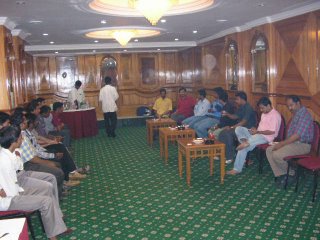
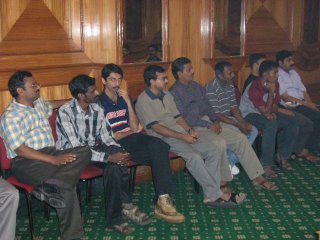
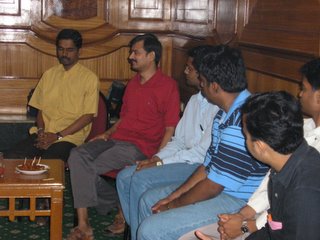
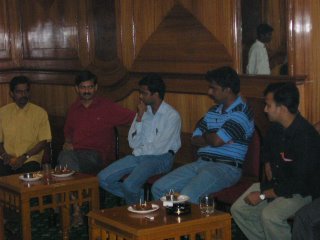

I could not blog about the farewell party on time, since I was really busy on certain official matters and am relaxed a bit now to talk about the farewell.
The farewell party to Satya was held at around 7 p.m. on 30th December 2005 at Hotel Ramada Raj Paris. It was good to see all the CI Chennaites together (except few). Everybody felt (rather feel) that it's really hard to miss him. Some took a chance to talk about their experience with him. He has been so nice, friendly and helpful to all of us.
We all whole-heartedly wish him a bright career for his new role.
Please find here, some of the snaps taken at the party.
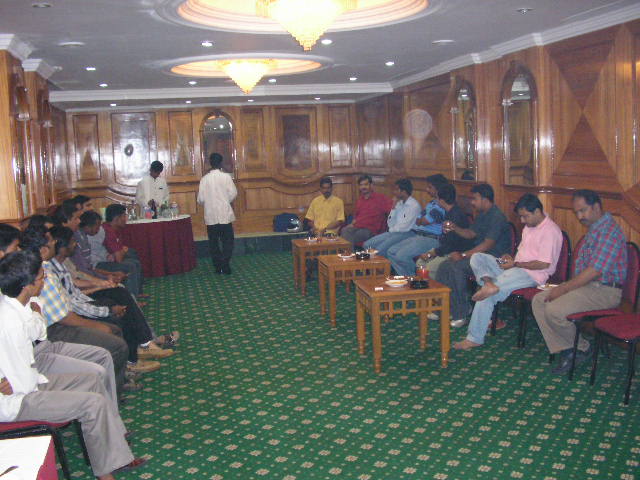


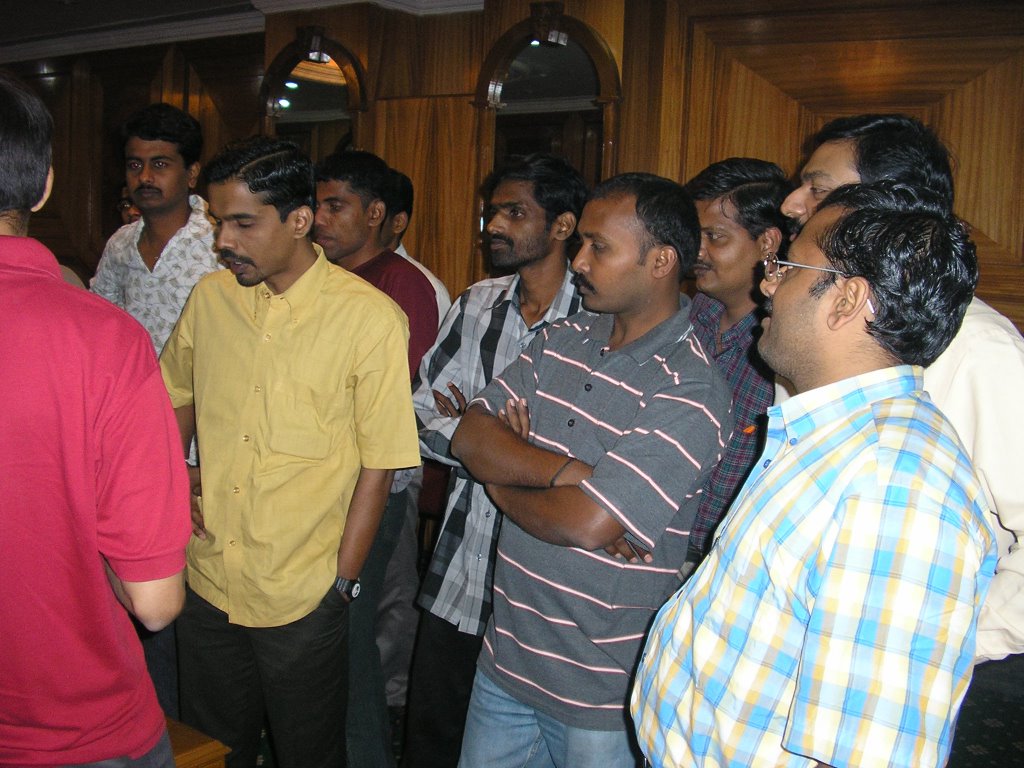
Many more rich Indians than rich taxpayers!
The Government has gathered more intelligence on the extent of black money in the economy from the Annual Information Returns (AIRs) on high value transactions filed by various agencies with the Income-tax Department.
While official information is that the number of people with taxable income of Rs 10 lakh or more is just over 80,000, as per the AIRs, over three lakh Indians spent Rs 2 lakh or more in 2004-05 to buy Mutual Fund (MF) units.
Such transactions exceeded an aggregate value of Rs 7 lakh crore according to AIRs filed by funds. Banks have reported that nearly three lakh Indians deposited more than Rs 10 lakh in savings accounts, amounting to a total of Rs 42,000 crore in 2004-05.
As per information furnished by credit card issuers, more than two lakh people purchased goods/services priced at over Rs 2 lakh through credit cards in transactions that added up to Rs 5,000 crore. Significantly, the AIR data indicate that Indians' tendency to save in physical assets like gold and property, rather than in financial assets, may be on the wane.
Capital markets may still be used by less than 1% Indians, but many are investing aggressively in equity.
The Government has gathered more intelligence on the extent of black money in the economy from the Annual Information Returns (AIRs) on high value transactions filed by various agencies with the Income-tax Department.
While official information is that the number of people with taxable income of Rs 10 lakh or more is just over 80,000, as per the AIRs, over three lakh Indians spent Rs 2 lakh or more in 2004-05 to buy Mutual Fund (MF) units.
Such transactions exceeded an aggregate value of Rs 7 lakh crore according to AIRs filed by funds. Banks have reported that nearly three lakh Indians deposited more than Rs 10 lakh in savings accounts, amounting to a total of Rs 42,000 crore in 2004-05.
As per information furnished by credit card issuers, more than two lakh people purchased goods/services priced at over Rs 2 lakh through credit cards in transactions that added up to Rs 5,000 crore. Significantly, the AIR data indicate that Indians' tendency to save in physical assets like gold and property, rather than in financial assets, may be on the wane.
Capital markets may still be used by less than 1% Indians, but many are investing aggressively in equity.
Wednesday, January 11, 2006

Tuesday, January 03, 2006

Any problem with your bank ?
Do you face any problem with your banker ?
Are your queries to banks not attended properly ?
Here's the solution to reach the authority whose responsibilty is to take up your matter to the concerned bank official and get it attended.
Perhaps, you can try this and see how the response is.
Please find the advertisement which was carried on the newspapers.
Monday, January 02, 2006
Suggestion to raise basic tax exemption limit to Rs 1.5 lakh: PHDCCI
The PHD Chamber of Commerce and Industry has urged the Government to restructure the income-tax slabs and increase the basic exemption limit for income-tax to Rs 1.5 lakh.
In its pre-budget memorandum submitted to the Finance Ministry, the chamber has said the slabs of income on which tax is levied at different rates are in a very narrow range and need to be restructured keeping in view the ground realities, including inflation.
The Chamber has said that in India, the income level on which tax at maximum marginal rate is levied is far lower than income level on which maximum marginal rates are levied in a large number of developing and emerging economies.
Even if the purchase parity of the rupee forms the basis, the cost of some of the basic necessities in metropolitan cities in India, such as housing, energy, transport, food products, medical care, etc, are comparable with that in most of the advanced countries.
This disparity must be redressed. The maximum marginal rate of 30 per cent should be made applicable to incomes exceeding Rs 5,00,000 instead of the present level of Rs 2,50,000.
The chamber has further urged the Government to reintroduce standard deduction under the Income Tax Act as salaried individuals cannot claim other relief that are allowed to business class assessees.
By allowing a deduction for genuine cost of earning to the employees, standard deduction had been a step to ensure equity amongst salary earners vis-à-vis persons drawing income from other sources such as business or profession.
The PHD Chamber of Commerce and Industry has urged the Government to restructure the income-tax slabs and increase the basic exemption limit for income-tax to Rs 1.5 lakh.
In its pre-budget memorandum submitted to the Finance Ministry, the chamber has said the slabs of income on which tax is levied at different rates are in a very narrow range and need to be restructured keeping in view the ground realities, including inflation.
The Chamber has said that in India, the income level on which tax at maximum marginal rate is levied is far lower than income level on which maximum marginal rates are levied in a large number of developing and emerging economies.
Even if the purchase parity of the rupee forms the basis, the cost of some of the basic necessities in metropolitan cities in India, such as housing, energy, transport, food products, medical care, etc, are comparable with that in most of the advanced countries.
This disparity must be redressed. The maximum marginal rate of 30 per cent should be made applicable to incomes exceeding Rs 5,00,000 instead of the present level of Rs 2,50,000.
The chamber has further urged the Government to reintroduce standard deduction under the Income Tax Act as salaried individuals cannot claim other relief that are allowed to business class assessees.
By allowing a deduction for genuine cost of earning to the employees, standard deduction had been a step to ensure equity amongst salary earners vis-à-vis persons drawing income from other sources such as business or profession.
Thursday, December 29, 2005
Tax net may get wider for credit card services
The Central Board of Excise and Customs is examining the possibility of making a case for charging service tax with retrospective effect from 2001 on "service charges" and "commissions" received by banks on services rendered in relation to credit cards.
According to officials, several banks including American Express, SBI, Standard Chartered, ICICI and HSBC could come under the scanner of the revenue department regarding the collection of such charges.
The argument of the department is that service charges recovered by the banks on account of swiping of credit cards and commissions received by the visa or master cards or the card issuing bank fall in the category of services.
These are, therefore, amenable to service tax under the category of "banking and financial services" with effect from July 2001, they said.
The Indian Banks' Association has already expressed to the government its opposition to the proposal.
"Technically, this is a sort of funding arrangement with merchant establishments. Besides, this was not mentioned in the coverage of service tax at the time the circular was issued by the government. It is not a fee that banks are receiving during their dealings with customers," sources said.
So, next time when you pay service charge for swiping your credit card, you might face an additional charge of 10.2 % towards service tax.
The Central Board of Excise and Customs is examining the possibility of making a case for charging service tax with retrospective effect from 2001 on "service charges" and "commissions" received by banks on services rendered in relation to credit cards.
According to officials, several banks including American Express, SBI, Standard Chartered, ICICI and HSBC could come under the scanner of the revenue department regarding the collection of such charges.
The argument of the department is that service charges recovered by the banks on account of swiping of credit cards and commissions received by the visa or master cards or the card issuing bank fall in the category of services.
These are, therefore, amenable to service tax under the category of "banking and financial services" with effect from July 2001, they said.
The Indian Banks' Association has already expressed to the government its opposition to the proposal.
"Technically, this is a sort of funding arrangement with merchant establishments. Besides, this was not mentioned in the coverage of service tax at the time the circular was issued by the government. It is not a fee that banks are receiving during their dealings with customers," sources said.
So, next time when you pay service charge for swiping your credit card, you might face an additional charge of 10.2 % towards service tax.
Friday, December 23, 2005
Non-acceptance of Small Coins is an offence: clarifies RBI
The Reserve Bank of India has come across reports that banks are reluctant to accept 50 paise and 25 paise coins.
A recent study conducted by the Reserve Bank through the Birla Institute of Technology (BITS), Pilani also suggests that similar reluctance is exhibited by shopkeepers and traders.
The Reserve Bank of India states categorically that all small denomination coins including those of 50 paise and 25 paise coins are legal tender and non-acceptance of any such coins is an offence.
The Reserve Bank has advised all banks to desist from any such restrictive practice. Members of public should assert their right to get appropriate change and acceptance of all denomination coins by banks in exchange.
The Reserve Bank of India has come across reports that banks are reluctant to accept 50 paise and 25 paise coins.
A recent study conducted by the Reserve Bank through the Birla Institute of Technology (BITS), Pilani also suggests that similar reluctance is exhibited by shopkeepers and traders.
The Reserve Bank of India states categorically that all small denomination coins including those of 50 paise and 25 paise coins are legal tender and non-acceptance of any such coins is an offence.
The Reserve Bank has advised all banks to desist from any such restrictive practice. Members of public should assert their right to get appropriate change and acceptance of all denomination coins by banks in exchange.
Search engines selling ad space may be taxed
The Authority for Advance Rulings has said that Google Online India Pvt Ltd, a wholly owned subsidiary of US-based Google International LLC, will have to pay service tax for selling advertisement space on its search site to Indian entities.
This can set a precedent for search engines with offices in India falling in the ambit of the tax. The advance ruling last week noted that the proposed activity of Google India to sell space on its site tantamount to providing a service to advertisers and clients. "From this angle, the applicant will be covered by the definition of advertising agency," it said. When contacted, Google executives said they were still examining the ruling and did not wish to comment on it.
A ruling by the advance authority is binding on the company with immediate effect unless it decides to appeal against the verdict. The search engine had approached the Advance Ruling Authority in August this year, seeking clarifications on whether providing selling space for advertisement on the Google website would be exempt from service tax or was classifiable as advertisement service, computer network service, business auxiliary service or any other taxable service.
In its application, Google had said the service it proposed to provide did not attract service tax.
The Authority for Advance Rulings has said that Google Online India Pvt Ltd, a wholly owned subsidiary of US-based Google International LLC, will have to pay service tax for selling advertisement space on its search site to Indian entities.
This can set a precedent for search engines with offices in India falling in the ambit of the tax. The advance ruling last week noted that the proposed activity of Google India to sell space on its site tantamount to providing a service to advertisers and clients. "From this angle, the applicant will be covered by the definition of advertising agency," it said. When contacted, Google executives said they were still examining the ruling and did not wish to comment on it.
A ruling by the advance authority is binding on the company with immediate effect unless it decides to appeal against the verdict. The search engine had approached the Advance Ruling Authority in August this year, seeking clarifications on whether providing selling space for advertisement on the Google website would be exempt from service tax or was classifiable as advertisement service, computer network service, business auxiliary service or any other taxable service.
In its application, Google had said the service it proposed to provide did not attract service tax.
Friday, December 09, 2005
Provident Fund interest rate dropped from 9.50% to 8.50%
The approximately four crore subscribers of the Employees Provident Fund Organisation (EPFO) will have to undergo a loss of one percentage interest, compared to last year, on their provident fund deposits.
The Central Board of Trustees (CBT) of EPFO on 7-12-2005 finally announced a 8.50% interest for provident fund deposits for 2005-06, against last year's 9.50%. The Labour Minister, Mr K. Chandrasekhar Rao, who is the Chairman of the EPFO, said that, even for paying 8.50% interest, there would be a shortfall of Rs 370 crore.
The Minister said he will not seek Government support for raising this Rs 370 crore but will look at ways of generating resources internally.
Though dropping of rate by 1% is not acceptable, I feel 8.50% is still a reasonable return for a guaranteed investment like this. The concerned department should look at investing the monies in large guaranteed securities which yield more returns so that higher benefits can be passed on to the mass.
The approximately four crore subscribers of the Employees Provident Fund Organisation (EPFO) will have to undergo a loss of one percentage interest, compared to last year, on their provident fund deposits.
The Central Board of Trustees (CBT) of EPFO on 7-12-2005 finally announced a 8.50% interest for provident fund deposits for 2005-06, against last year's 9.50%. The Labour Minister, Mr K. Chandrasekhar Rao, who is the Chairman of the EPFO, said that, even for paying 8.50% interest, there would be a shortfall of Rs 370 crore.
The Minister said he will not seek Government support for raising this Rs 370 crore but will look at ways of generating resources internally.
Though dropping of rate by 1% is not acceptable, I feel 8.50% is still a reasonable return for a guaranteed investment like this. The concerned department should look at investing the monies in large guaranteed securities which yield more returns so that higher benefits can be passed on to the mass.
Sunday, November 27, 2005
What is a Mutual Fund ?
A mutual fund is an entity which combines, or pools, investors' money and, generally, purchases stocks or bonds. Ideally, a fund's size and resultant efficiency, combined with experienced management, provide advantages for investors that include diversification, expert stock and bond selection, low costs, and convenience.
The assets of a mutual fund consist almost entirely of the securities it holds in its portfolio. The most common type of mutual fund, called an open-end fund, allows investors to buy and sell stock in it on an ongoing basis.
How it Works ?
The mutual fund issues shares of stock (just like any other corporation) to investors in exchange for cash. It is interesting to note that funds do not issue a pre-determined amount of stock, as do most corporations; new shares are issued as each new investment is made. Investors thus become part owners of the fund itself, and thereby the assets of the fund. The fund, in turn, uses investors' cash to purchase securities, such as stocks and bonds. As mentioned above, the primary assets of a fund are the securities it invests in (other assets, such as equipment, are a relatively small part of the total assets of a fund).
How to invest in Mutual Funds?
Here’s the list of five ways in which you can buy your fund units.
1. Get in touch with the Asset Management Company
The first step is to track the AMC -- as fund houses are known -- online.
Once you get onto their Web site, you will get their office addresses, phone numbers and a contact e-mail address. You will even be able to transact online with some of them.
Online addresses of the AMCs
ABN AMRO Mutual Fund
Benchmark Mutual Fund
Birla Sun Life Mutual Fund
BOB Mutual Fund
Canbank Mutual Fund
Chola Mutual Fund
Deutsche Mutual Fund
DSP Merrill Lynch Mutual Fund
Escorts Mutual Fund
Fidelity Mutual Fund
Franklin Templeton Mutual Fund
GIC Mutual Fund
HDFC Mutual Fund
HSBC Mutual Fund
ING Vysya Mutual Fund
J M Financial Mutual Fund
Kotak Mahindra Mutual Fund
LIC Mutual Fund
Morgan Stanley Mutual Fund
Principal Mutual Fund
Prudential ICICI Mutual Fund
Reliance Mutual Fund
Sahara Mutual Fund
SBI Mutual Fund
Standard Chartered Mutual Fund
Sundaram Mutual Fund
Tata Mutual Fund
Taurus Mutual Fund
UTI Mutual Fund
Invest online with the mutual fund
Some mutual fund Web sites allow you to invest online. However, you must check if you have an account with the banks they have partnered with.
For example, Prudential ICICI Mutual Fund allows you to buy funds online if you have a banking account with any of the following banks: Centurion Bank, HDFC Bank, ICICI Bank, IDBI Bank and UTI Bank.
You can buy units of SBI Mutual Fund's schemes only if you have an account with the State Bank of India or HDFC Bank.
Get in touch with the fund house
By going online, you will be able to locate the fund house's address and phone number (toll free number in some cases). You can call and request them to send an agent over.
Or, if you want, go over personally. Do make an appointment; you may end up wasting time if the person you want to speak to is not available.
Some, like Prudential ICICI Mutual Fund, have a form you can fill and submit online. Do so and they will send someone over to meet you.
2. Visit your bank
A number of banks are mutual fund agents.
Just walk into your branch and ask if they are selling any funds. See if they have a tie-up with the fund house you want to invest in.
3. Ask around
Ask your colleagues, neighbors, friends and relatives. Someone will know an agent. Just ask them for his contact details or ask that he get in touch with you.
4. Visit the AMFI website
The Web site of the Association of Mutual Funds in India has a list of mutual fund agents across the country.
Under the heading Investors Zone, you will find another one called ARN Search. This refers to the AMFI Registration Number.
Click on it and you will arrive at a search page. You can locate an agent in your vicinity by just putting in your PIN code or name of your city.
5. Check the online finance portals
Do you have an online trading account? Then you could check if they also sell mutual funds online.
If you do not have an online trading account and are considering opening one, you could look for a player that offers both.
Some like ICICI Direct sell funds online. But you must have a trading account with them. Others, like India Bulls and Motilal Oswal, do not have this facility online but if you call and leave your contact details, they will send an agent over.
Here are some of the prominent players.
5 paisa
Geojit Securities
HDFC Securities
ICICI Direct
India Bulls
InvestSmart Online
Investmentz.com
Kotak Street
Motilal Oswal
Sharekhan
A mutual fund is an entity which combines, or pools, investors' money and, generally, purchases stocks or bonds. Ideally, a fund's size and resultant efficiency, combined with experienced management, provide advantages for investors that include diversification, expert stock and bond selection, low costs, and convenience.
The assets of a mutual fund consist almost entirely of the securities it holds in its portfolio. The most common type of mutual fund, called an open-end fund, allows investors to buy and sell stock in it on an ongoing basis.
How it Works ?
The mutual fund issues shares of stock (just like any other corporation) to investors in exchange for cash. It is interesting to note that funds do not issue a pre-determined amount of stock, as do most corporations; new shares are issued as each new investment is made. Investors thus become part owners of the fund itself, and thereby the assets of the fund. The fund, in turn, uses investors' cash to purchase securities, such as stocks and bonds. As mentioned above, the primary assets of a fund are the securities it invests in (other assets, such as equipment, are a relatively small part of the total assets of a fund).
How to invest in Mutual Funds?
Here’s the list of five ways in which you can buy your fund units.
1. Get in touch with the Asset Management Company
The first step is to track the AMC -- as fund houses are known -- online.
Once you get onto their Web site, you will get their office addresses, phone numbers and a contact e-mail address. You will even be able to transact online with some of them.
Online addresses of the AMCs
ABN AMRO Mutual Fund
Benchmark Mutual Fund
Birla Sun Life Mutual Fund
BOB Mutual Fund
Canbank Mutual Fund
Chola Mutual Fund
Deutsche Mutual Fund
DSP Merrill Lynch Mutual Fund
Escorts Mutual Fund
Fidelity Mutual Fund
Franklin Templeton Mutual Fund
GIC Mutual Fund
HDFC Mutual Fund
HSBC Mutual Fund
ING Vysya Mutual Fund
J M Financial Mutual Fund
Kotak Mahindra Mutual Fund
LIC Mutual Fund
Morgan Stanley Mutual Fund
Principal Mutual Fund
Prudential ICICI Mutual Fund
Reliance Mutual Fund
Sahara Mutual Fund
SBI Mutual Fund
Standard Chartered Mutual Fund
Sundaram Mutual Fund
Tata Mutual Fund
Taurus Mutual Fund
UTI Mutual Fund
Invest online with the mutual fund
Some mutual fund Web sites allow you to invest online. However, you must check if you have an account with the banks they have partnered with.
For example, Prudential ICICI Mutual Fund allows you to buy funds online if you have a banking account with any of the following banks: Centurion Bank, HDFC Bank, ICICI Bank, IDBI Bank and UTI Bank.
You can buy units of SBI Mutual Fund's schemes only if you have an account with the State Bank of India or HDFC Bank.
Get in touch with the fund house
By going online, you will be able to locate the fund house's address and phone number (toll free number in some cases). You can call and request them to send an agent over.
Or, if you want, go over personally. Do make an appointment; you may end up wasting time if the person you want to speak to is not available.
Some, like Prudential ICICI Mutual Fund, have a form you can fill and submit online. Do so and they will send someone over to meet you.
2. Visit your bank
A number of banks are mutual fund agents.
Just walk into your branch and ask if they are selling any funds. See if they have a tie-up with the fund house you want to invest in.
3. Ask around
Ask your colleagues, neighbors, friends and relatives. Someone will know an agent. Just ask them for his contact details or ask that he get in touch with you.
4. Visit the AMFI website
The Web site of the Association of Mutual Funds in India has a list of mutual fund agents across the country.
Under the heading Investors Zone, you will find another one called ARN Search. This refers to the AMFI Registration Number.
Click on it and you will arrive at a search page. You can locate an agent in your vicinity by just putting in your PIN code or name of your city.
5. Check the online finance portals
Do you have an online trading account? Then you could check if they also sell mutual funds online.
If you do not have an online trading account and are considering opening one, you could look for a player that offers both.
Some like ICICI Direct sell funds online. But you must have a trading account with them. Others, like India Bulls and Motilal Oswal, do not have this facility online but if you call and leave your contact details, they will send an agent over.
Here are some of the prominent players.
5 paisa
Geojit Securities
HDFC Securities
ICICI Direct
India Bulls
InvestSmart Online
Investmentz.com
Kotak Street
Motilal Oswal
Sharekhan
Sunday, October 30, 2005
Tax Incentives on Home Loans
Yes, such a thing exists when you buy a home. The tax laws allow incentive to encourage people to buy homes. Hence, make full use of them.
Incentive 1 : Interest on housing loans is exempt up to a ceiling of Rs. 1,50,000 (sec 24)
Incentive 2 : A Deduction of Rs. 1,00,000 from taxable income is available for the repayment of principal amount on home loan. (Note: This is the consolidated ceiling amount under section 80C which allows the rebate for investments like contribution to Provident Fund, Life Insurance Premium, Mutual Funds etc)
Tax Incentives – Make your Home Loan cheaper than you think
How can working professionals plan their home loan to maximise interest and tax savings?
From the point of view of economics, the ideal loan investor should avail of is Rs.20 lakh. The rate of interest on this amount would be just about 3.525% per annum only. How ???
Let us presume that a senior executive receiving a salary of Rs.5 lakh per annum is interested in a loan of Rs.20 lakh. The rate of interest charged on this loan is 7.5% per annum.
Thus the total interest payable for one year on Rs.20 lakh comes to only Rs.1,50,000. The maximum amount of interest that will be allowed as a deduction while computing the income of the individual from all sources taken together is restricted to a maximum sum of Rs.1,50,000/- per annum.
Thus, the entire interest payment of say Rs.1,50,000/- would be allowed as a deduction to this executive from his salary income of Rs. 5 lakh. This implies that the executive would be saving income tax on Rs.1,50,000/- being the interest payment. The tax saving would be at the rate of 33% being the maximum marginal rate of income tax applicable to him.Thus, the saving on account of deduction of interest from the total income for salaried executive comes to 49,500.
Hence, we find that from the total interest payment of Rs.1,50,000/- payable by the executive on loan of Rs. 20 lakh @ 7.5 % interest has actually been paid by the income tax department by granting him full deduction in respect of such interest payment on loan. There by the net outgo of interest on the loan comes to Rs.1,00,500/- (Rs.1,50,000 – Rs.49,500).
Thus the net impact of interest on the executive’s loan of Rs.20 lakh comes to Rs.1,00,500/-. This in fact, is just 5.02% rate of interest per annum.
If we go a step further and take into consideration the impact of tax saving as a result of the deduction from taxable income on account of home loan principal repayment.
We find that the said executive is able to save income tax to the tune of Rs. 30,000/-. Hence from the above amount of Rs 1,00,500/- if we deduct Rs.30,000/- the net impact comes to a mere Rs 70,500 - Rs.1,50,000 interest Rs.49,500/- tax saving on interest payment Rs.30,000/- cash flow saving as a result of principal repayment.
Thus, on a total loan of Rs.20 lakh, the net impact of out flow after tax comes to Rs.70,500/- which means effective interest rate of merely 3.525% in respect of a Rs. 20 lakh loan.
Yes, such a thing exists when you buy a home. The tax laws allow incentive to encourage people to buy homes. Hence, make full use of them.
Incentive 1 : Interest on housing loans is exempt up to a ceiling of Rs. 1,50,000 (sec 24)
Incentive 2 : A Deduction of Rs. 1,00,000 from taxable income is available for the repayment of principal amount on home loan. (Note: This is the consolidated ceiling amount under section 80C which allows the rebate for investments like contribution to Provident Fund, Life Insurance Premium, Mutual Funds etc)
Tax Incentives – Make your Home Loan cheaper than you think
How can working professionals plan their home loan to maximise interest and tax savings?
From the point of view of economics, the ideal loan investor should avail of is Rs.20 lakh. The rate of interest on this amount would be just about 3.525% per annum only. How ???
Let us presume that a senior executive receiving a salary of Rs.5 lakh per annum is interested in a loan of Rs.20 lakh. The rate of interest charged on this loan is 7.5% per annum.
Thus the total interest payable for one year on Rs.20 lakh comes to only Rs.1,50,000. The maximum amount of interest that will be allowed as a deduction while computing the income of the individual from all sources taken together is restricted to a maximum sum of Rs.1,50,000/- per annum.
Thus, the entire interest payment of say Rs.1,50,000/- would be allowed as a deduction to this executive from his salary income of Rs. 5 lakh. This implies that the executive would be saving income tax on Rs.1,50,000/- being the interest payment. The tax saving would be at the rate of 33% being the maximum marginal rate of income tax applicable to him.Thus, the saving on account of deduction of interest from the total income for salaried executive comes to 49,500.
Hence, we find that from the total interest payment of Rs.1,50,000/- payable by the executive on loan of Rs. 20 lakh @ 7.5 % interest has actually been paid by the income tax department by granting him full deduction in respect of such interest payment on loan. There by the net outgo of interest on the loan comes to Rs.1,00,500/- (Rs.1,50,000 – Rs.49,500).
Thus the net impact of interest on the executive’s loan of Rs.20 lakh comes to Rs.1,00,500/-. This in fact, is just 5.02% rate of interest per annum.
If we go a step further and take into consideration the impact of tax saving as a result of the deduction from taxable income on account of home loan principal repayment.
We find that the said executive is able to save income tax to the tune of Rs. 30,000/-. Hence from the above amount of Rs 1,00,500/- if we deduct Rs.30,000/- the net impact comes to a mere Rs 70,500 - Rs.1,50,000 interest Rs.49,500/- tax saving on interest payment Rs.30,000/- cash flow saving as a result of principal repayment.
Thus, on a total loan of Rs.20 lakh, the net impact of out flow after tax comes to Rs.70,500/- which means effective interest rate of merely 3.525% in respect of a Rs. 20 lakh loan.
Tuesday, October 18, 2005
Service Tax
I just thought of letting you know the services that are being covered under Service Tax Net as of today.
I also came to know few clarifications by the department which might be useful for the people concerned:
SERVICE TAX - 1
AD firm's Service tax liability-Draft Circular
F.No.341/43/2005-TRU
Board has examined the suggestion seeking to issue a comprehensive circular on levy of service tax under Section 65 (105) (e) of the Finance act, 1994. For this reason, various circulars/instructions issued from time to time, including the following three circulars issued by the Board, relevant statutory provisions and other materials facts relating to levy of service tax on any service provided to a client by an advertising agency in relation to advertisement in any manner under Section 65(105) (e) of the Finance Act, 1994 have been taken into account.
(i) Circular F.No.341/43/96 dated 31.10.1996:
(ii) Circular F.No.345/4/97 dated 16.8.99:
(iii) Circular F.No.168/01/2003 - CX.4 dated 28.10.2003:
2. Service tax is leviable under Section 65 (105) (e) on any service provided to a client by an advertising agency in relation to advertising in any manner. The term "advertisement" is defined under Section 65 (2) and the term "advertising agency" is defined under section 65 (3). Advertisement includes hoarding or audio visual representation. Advertising agency means any commercial concern providing any service connected with display or exhibition of advertisement.
3. Section 65 (105) (e) is applicable to any service provided in relation to advertising in any manner. Advertisement includes hoarding or any other audio visual representation provided by an advertising agency connected with display or exhibition of advertisement. The scope and coverage of the taxable service is to be understood in the context of the said legal provisions.
4. Advertising agency obtains space and time in getting advertisement published in print or electronic media. Such services are used by an advertising agency to provide advertising service to a client in respect of display or exhibition of advertisement. Such services, being an input service, form an integral part of the taxable service provided under Section 65 (105) (e).
5. As regards value of the taxable service provided by the advertising agency to the client, the amount paid by the advertising agency to the print or electronic media for display or exhibition of advertisement is includable as part of the total consideration paid by the client to the advertising agency for providing such taxable service. Accordingly, the service tax is to be levied on the total amount paid by the client to the advertising agency inclusive of the amount paid by the advertising agency to the media.
6. Advertising agency negotiates the rate and other terms and conditions with the media for obtaining the space for advertisement. Advertising agency and the media are the two parties involved in the transaction and the contractual obligations exist only between the said two parties. Advertising agency, as per the contract, is responsible for paying the amount to the media for getting the advertisement published. The client is not party to the transaction or contract with the media and hence does not have any legal obligation towards the media in relation to the said transaction. The transaction between the Advertising Agency and the Media is on Principal-to-Principal basis. Advertising agency is not acting as an agent of the client in such transactions.
7. The services provided by the media is actually received by the advertising agency and used as an input service for providing the taxable service to the client. The service provided by the advertising agency to its client is a composite and single service and use of advertisement space as an input service cannot be treated independently as a service separately provided on client's own account. There is no legal requirement for the advertising agency to specifically mention the actual payment made by him to the media in the invoice issued to the client. Whether on not the amount paid or payable to the media by an advertising agent is separately mentioned in the invoice is not relevant.
The advertising agency does not necessarily receive the exact amount paid or payable to the media from the client. In other words, advertising agency does not act as an agent of the customer when he pays the amount to the media. Inputs or input services are integral part of the taxable service provided and the value of all such inputs and input services are liable to be included in determining the consideration for the purpose of levy of service tax. Therefore, the amount paid by the advertising agency to the media for obtaining space for display or exhibition, being in the nature of input service used in providing the taxable service, is liable to be included in the value of the taxable service.
8. As regards levy of service tax under Section 65 (105) (e) on a given service, all the material facts of the individual case have to be considered in the light of the definition of taxable service and also the definition of "advertisement" under Section 65 (2) and " advertising agency" under Section 65(3). The significance of the terms "any service" and "any manner" mentioned in Section 65 (105) (e) need to be appropriately taken into account while taking a view on such issues.
9. This circular is issued in super session of the three circulars mentioned in para 1 and all other circulars and instructions so far issued in relation to levy of service tax under Section 65 (105) (e) of the Finance Act, 1994.
SERVICE TAX - 2
Leviability of service tax on maintenance or repair of software
CIRCULAR NO 81/2/2005-ST, dated 7-10-2005
Board has examined the leviability of service tax on maintenance or repair or servicing of software under section 65(105)(zzg) read with section 65 (64) of the Finance Act , 1994.
2. Supreme Court in the case of Tata Consultancy Services vs State of Andhra Pradesh (Civil Appeal no 2582 0f 1998) has observed that all the tests required to satisfy the definition of goods are possible in the case of software and in computer software the intellectual property has been incorporated on media for the purpose of transfer and software and media cannot be split up. Therefore, sale of computer software falls within the scope of sale of goods. Supreme Court has also observed that they are in agreement with the view that there is no distinction between branded and unbranded software.
3. Branded software, also known as canned software, sold off the shelf, is transferred in a media and is sold as such and the Supreme Court has decided that such branded software falls within the definition of goods. In the case of unbranded / customized software, the supplier develops the software and thereafter transfers the software so developed in a media and it is taken to the customer's premises for loading in their system. Thus, in the case of unbranded / customized software also, the intellectual property namely software is incorporated in a media for use. Supreme Court has held that software in a media is goods.
4. Any service provided to a customer by any person in relation to maintenance or repair is leviable to service tax under section 65(105) (zzg) of the Finance act , 1994. "Maintenance or repair" is defined under section 65(64) of the said Act. Accordingly, "maintenance or repair" means any service provided in relation to maintenance or repair or servicing of any goods or equipment.
5. Software, being goods, any service in relation to maintenance or repair or servicing of software is leviable to service tax under section 65(105)(zzg) read with section 65 (64) of the Finance Act, 1994.
6. These instructions are issued taking into account the said decision of the Supreme Court , and in supersession of all earlier clarifications / circulars issued on the above subject.
I just thought of letting you know the services that are being covered under Service Tax Net as of today.

I also came to know few clarifications by the department which might be useful for the people concerned:
SERVICE TAX - 1
AD firm's Service tax liability-Draft Circular
F.No.341/43/2005-TRU
Board has examined the suggestion seeking to issue a comprehensive circular on levy of service tax under Section 65 (105) (e) of the Finance act, 1994. For this reason, various circulars/instructions issued from time to time, including the following three circulars issued by the Board, relevant statutory provisions and other materials facts relating to levy of service tax on any service provided to a client by an advertising agency in relation to advertisement in any manner under Section 65(105) (e) of the Finance Act, 1994 have been taken into account.
(i) Circular F.No.341/43/96 dated 31.10.1996:
(ii) Circular F.No.345/4/97 dated 16.8.99:
(iii) Circular F.No.168/01/2003 - CX.4 dated 28.10.2003:
2. Service tax is leviable under Section 65 (105) (e) on any service provided to a client by an advertising agency in relation to advertising in any manner. The term "advertisement" is defined under Section 65 (2) and the term "advertising agency" is defined under section 65 (3). Advertisement includes hoarding or audio visual representation. Advertising agency means any commercial concern providing any service connected with display or exhibition of advertisement.
3. Section 65 (105) (e) is applicable to any service provided in relation to advertising in any manner. Advertisement includes hoarding or any other audio visual representation provided by an advertising agency connected with display or exhibition of advertisement. The scope and coverage of the taxable service is to be understood in the context of the said legal provisions.
4. Advertising agency obtains space and time in getting advertisement published in print or electronic media. Such services are used by an advertising agency to provide advertising service to a client in respect of display or exhibition of advertisement. Such services, being an input service, form an integral part of the taxable service provided under Section 65 (105) (e).
5. As regards value of the taxable service provided by the advertising agency to the client, the amount paid by the advertising agency to the print or electronic media for display or exhibition of advertisement is includable as part of the total consideration paid by the client to the advertising agency for providing such taxable service. Accordingly, the service tax is to be levied on the total amount paid by the client to the advertising agency inclusive of the amount paid by the advertising agency to the media.
6. Advertising agency negotiates the rate and other terms and conditions with the media for obtaining the space for advertisement. Advertising agency and the media are the two parties involved in the transaction and the contractual obligations exist only between the said two parties. Advertising agency, as per the contract, is responsible for paying the amount to the media for getting the advertisement published. The client is not party to the transaction or contract with the media and hence does not have any legal obligation towards the media in relation to the said transaction. The transaction between the Advertising Agency and the Media is on Principal-to-Principal basis. Advertising agency is not acting as an agent of the client in such transactions.
7. The services provided by the media is actually received by the advertising agency and used as an input service for providing the taxable service to the client. The service provided by the advertising agency to its client is a composite and single service and use of advertisement space as an input service cannot be treated independently as a service separately provided on client's own account. There is no legal requirement for the advertising agency to specifically mention the actual payment made by him to the media in the invoice issued to the client. Whether on not the amount paid or payable to the media by an advertising agent is separately mentioned in the invoice is not relevant.
The advertising agency does not necessarily receive the exact amount paid or payable to the media from the client. In other words, advertising agency does not act as an agent of the customer when he pays the amount to the media. Inputs or input services are integral part of the taxable service provided and the value of all such inputs and input services are liable to be included in determining the consideration for the purpose of levy of service tax. Therefore, the amount paid by the advertising agency to the media for obtaining space for display or exhibition, being in the nature of input service used in providing the taxable service, is liable to be included in the value of the taxable service.
8. As regards levy of service tax under Section 65 (105) (e) on a given service, all the material facts of the individual case have to be considered in the light of the definition of taxable service and also the definition of "advertisement" under Section 65 (2) and " advertising agency" under Section 65(3). The significance of the terms "any service" and "any manner" mentioned in Section 65 (105) (e) need to be appropriately taken into account while taking a view on such issues.
9. This circular is issued in super session of the three circulars mentioned in para 1 and all other circulars and instructions so far issued in relation to levy of service tax under Section 65 (105) (e) of the Finance Act, 1994.
SERVICE TAX - 2
Leviability of service tax on maintenance or repair of software
CIRCULAR NO 81/2/2005-ST, dated 7-10-2005
Board has examined the leviability of service tax on maintenance or repair or servicing of software under section 65(105)(zzg) read with section 65 (64) of the Finance Act , 1994.
2. Supreme Court in the case of Tata Consultancy Services vs State of Andhra Pradesh (Civil Appeal no 2582 0f 1998) has observed that all the tests required to satisfy the definition of goods are possible in the case of software and in computer software the intellectual property has been incorporated on media for the purpose of transfer and software and media cannot be split up. Therefore, sale of computer software falls within the scope of sale of goods. Supreme Court has also observed that they are in agreement with the view that there is no distinction between branded and unbranded software.
3. Branded software, also known as canned software, sold off the shelf, is transferred in a media and is sold as such and the Supreme Court has decided that such branded software falls within the definition of goods. In the case of unbranded / customized software, the supplier develops the software and thereafter transfers the software so developed in a media and it is taken to the customer's premises for loading in their system. Thus, in the case of unbranded / customized software also, the intellectual property namely software is incorporated in a media for use. Supreme Court has held that software in a media is goods.
4. Any service provided to a customer by any person in relation to maintenance or repair is leviable to service tax under section 65(105) (zzg) of the Finance act , 1994. "Maintenance or repair" is defined under section 65(64) of the said Act. Accordingly, "maintenance or repair" means any service provided in relation to maintenance or repair or servicing of any goods or equipment.
5. Software, being goods, any service in relation to maintenance or repair or servicing of software is leviable to service tax under section 65(105)(zzg) read with section 65 (64) of the Finance Act, 1994.
6. These instructions are issued taking into account the said decision of the Supreme Court , and in supersession of all earlier clarifications / circulars issued on the above subject.
Thursday, September 01, 2005
Mumbai Trip !!
Last Weekend, I was in Mumbai for some of the official duties.
It was very hot during the daytime and but so chill in the night.
My work in the office got almost over on Saturday itself.
The next day, my colleague Prasad took me to Iskcon and Mahalakshmi Temple (you can watch some of the Snaps taken there).
Also, we did a good shopping in Big Bazaar. In my opinion, Big Bazaar is a place where you can get all essentials and is really attractive - in terms of quality and price.
Last Weekend, I was in Mumbai for some of the official duties.
It was very hot during the daytime and but so chill in the night.
My work in the office got almost over on Saturday itself.
The next day, my colleague Prasad took me to Iskcon and Mahalakshmi Temple (you can watch some of the Snaps taken there).
Also, we did a good shopping in Big Bazaar. In my opinion, Big Bazaar is a place where you can get all essentials and is really attractive - in terms of quality and price.
Sunday, August 21, 2005
Trip to Sri Lanka !!
All of sudden during the first week of August 2005, an office tour plan cropped up in the minds of me and Hari (my colleague) to visit Lanka. I immediately started enquiring about the package.
I remembered that, some time back, I helped one of my friends to get a job in a travels company (through an HR guy). When I contacted him to enquire about the Lanka Package, I was assured that I could be offered an excellent package.
Confirming that the total cost would be within our budget, we stepped ahead to fix up the plan. After checking both of our work schedules, we finally fixed the date as 12th August 2005.
When other colleagues in office knew the plan, they started advising us about what are all the places we should visit in Lanka. I have to thank them at this moment for expressing their interest on our plan.
As the days were nearing the travel date, we were very much worried whether we could finish off all the pending work before that,,, but some how finished them all in the late night on 11th. We hove a sigh that we were ready for the travel.
Here's the itinerary:
Colombo, Nuwara Eliya, Kandy & Pinnawela (05 Days / 04 nights)
Day 01 - Friday - Airport/Colombo:
Arrived at the Bandaranaike International Airport and welcomed by the representative. We were given a Ford Pulsar car and a chauffer-guide for the complete trip.
Proceed to Colombo and check in at Hotel Grand Oriental.
Colombo is the commercial capital of the country and is the hub of the business community of the island. With a hive of activity during the daytime, it has a vibrant nightlife with many casinos and nightclubs. Colombo is a fascinating city with a comfortable blend of the East and West and a cozy mix of the past and the present.
In the evening, we visited CricInfo Lanka office, met Charlie, Chaminda and Manoj. We spent that evening freely with them sharing our ideas and thoughts on various topics (includes official matters too).
An unexpected incident happened in Colombo this day, was the assassination of Foreign minister Lakshman Kadiragamer. But to our surprise, the city was so cool and calm; and no terror happened as expected and mentioned in the media.
Day 02 - Saturday - Colombo:
This day, we had planned to have our city tour and shopping. We were worried whether we could make it because of the murder happened in the city, but we made it without any hassles.
City Tour of Colombo - This included visits to the old Parliament, the present Parliament, the Town Hall, the Fort and Pettah areas, Buddhist and Hindu Temples including the beautiful Gangaramaya Temple and the Shree Ponnambalavaneesvarar Temple.
Shopping was very exciting with visits to the Majestic City, Odel Unlimited, and the House of Fashion. Our shopping ate all the currencies on the hand :-)
Day 03 - Sunday - Nuwara Eliya :
Breakfast at the hotel. After Breakfast Proceeded to Nuwara Eliya via – Kitulgale.
Kitulgale is the Place where a Part of the famous Hollywood Film “Bridge on the River Kwai” was filmed in the year 1957. We happened to see an aged person there who acted as the jungle boy in the movie. He showed us some of the news-cuttings about the movie and explained how the movie was shot. As per the story of the movie, the bridge, which is originally located at River Kwai in Thailand, has to be blast in a scene. Since, the original bridge cannot be blasted, they found the identical river in this place, constructed a similar bridge and blasted it for the movie.
Then, a drive to Nuwara Eliya was through green hills covered with carpets of tea plantations interspersed by cascading waterfalls and winding roads. As you get closer to this much adored city of Nuwara Eliya also called “Little England” by the British, the salubrious climate greets you with nippy fresh air and its wintry atmosphere. This city located 6,000 ft above sea level, has many comely cottages, churches, a 18 hole Golf course, a lake and the park. It is a famous holiday resort for both local and foreign tourists.
Arrived in Nuwara Eliya and checked in at Hotel Galway Forest Lodge.
Tour the City with visits to the Sita Amman Temple – the location where King Ravana is supposed to have kept Sita hidden from Rama, the 18 holes Golf Course and Lake Gregory.
I have to tell you an incident happened in Sita Temple.
On the way to this temple, we had taken lots of snaps. When we were inside the temple and thought of capturing the footprint of Lord Hanuman (there is huge foot-print of Hanuman on a rock), we could NOT do that. Not only the footprint, we were unable to take any photo-shots inside the temple.
We then checked up the camera around 10 times, replaced batteries etc but everything went useless. We thought that since we used the camera continuously for 2 days, the camera went wrong and needs to be repaired (anyway, we had another digital camera but left at the room). When we were returning back to our hotel, we tried to take some snaps. To our surprise, it worked fine. We still don't know why it did NOT work inside the temple.
Overnight stay at the hotel.
Day 04 - Kandy :
Breakfast at the hotel.
Proceeded to Kandy, the last bastion of Sri Lankan rule and resistance to British Colonialism.
Enroute visited 18 feet Hanuman Temple build by Swamin Chinmayananda and a Tea Factory.
Arrived in Kandy and check in at Hotel Swiss Residence.
Had a City Tour of Kandy.
Kandy is a city of enchantment and retains its own culture, pace and aristocracy. It’s located in the center of the Island and is rather hilly although not as high as Nuwara Eliya.
The Temple of the Tooth is the focal point of the city with thousands of visitors worshipping to invoke blessings from the Sacred Tooth. The Bogambara Lake is by the side of the Temple which has a tiny island in the center.
The last king of the country – Shree Vickrama Rajasinghe who ruled from Kandy is said to have submerged “Ehelepola Kumarihamy” – the wife of one of his chieftains – in the lake which is surrounded by a parapet wall and much folklore.
There are numerous shrines and temples in and around Kandy where you will see rare paintings, frescoes and stone carvings.
The Royal Botanical Gardens contain rare flora both exotic and endemic with beautiful flowers wafted by the gentle breeze across the River – Mahaweli flowing alongside. The avenue of Palms is famous for memorable walks for many a visitor.
Attended a Cultural Dance Show in the evening. It was wonderful to watch that for one particular performance, the famous Tamil song 'Vaaraayo Vennilaavay' was sung by them and applaused by the tourists.
We had an opportunity to attend the famous anniversary function ' Perahara'.
Kandy’s biggest attraction is the "Esala Perahara". It is a 10-day pagent which leads up to until the full moon of the month of July. There are two kinds of pagents. The first is called the "Kumbal Perahera" which parades for the first 5 nights. Then the "Randoli Perahera" which parades the last 5 nights. The last nights perahera is the grandest of all. Randoli means the ‘Queen’s Palanquin’. Up to 1775 A.D palanquins were carried alongside the elephants in the perahera. The elephants are dressed in colourful silk costumes. The number of elephants increase daily making the perahera more spectacular each night. The Maligawa perahera is followed by those of the 4 devales(hindu temples). It is illuminated by torchbearers because it is held in the night.
First of all the whip crackers crack their whips to announce the Perehera. Next comes the flag bearers carrying all kinds of flags, followed by an official who is called the Peramunerala riding on the first elephant. After them come the drummers. The Gajanayake Nilame, who is a very high official, is the next in line. The highlight of the procession is the Maligawa Tusker carrying the tooth relic of Lord Buddha. The Tusker is in between the dancers and drummers.The Diyawadana Nilame who walks in all the oriental splendour comes after the Tusker. The palanquins, which are also called the randolis, come next. The water cutting ceremony is held at dawn followed by the last perahera on the full moon day.
Though it was a street procession, it was really tough to get tickets to watch the show. Somehow, our guide got tickets for us and we watched the show. The show was too good.
Overnight stay at the Hotel in Kandy
Day 05 - Kandy/Pinnawela/Airport:
Early breakfast at the hotel.
Proceed to the Bandaranaike International Airport via Pinnawela.
En route visited a Spice Garden in Mawanella.
Also visited the Elephant Orphanage in Pinnawela.
The Spice Garden contains many varieties of valuable indigenous as well as exotic spices and medicinal plants and herbs. These can be purchased raw as well as in prepared form to be used for flavouring of food and in ayurvedic treatment
The Orphanage was opened to care and protect elephants of varying age, size and maturity discovered lost, hurt or abandoned by their herds. You will find them well looked after at this foster home for them. They feed, bathe, play, fight and also mate in this environment and there are a few baby calves born in captivity at the orphanage. Bottle-feeding is done three times during the day and it is a treat to watch.

All the elephants (around 200) are taken to the river in the morning for bath. The best part of the show was that when we were standing near the gate to take snaps of the elephants, all were rushing towards us to proceed to the river. It was so thrilling to watch so closely this much number of elephants.
Arrived at the Bandaranaike International Airport at 12.30 p.m for departure.
CLICK HERE TO WATCH THE PHOTOS !!
~~~ End of Tour ~~~
All of sudden during the first week of August 2005, an office tour plan cropped up in the minds of me and Hari (my colleague) to visit Lanka. I immediately started enquiring about the package.
I remembered that, some time back, I helped one of my friends to get a job in a travels company (through an HR guy). When I contacted him to enquire about the Lanka Package, I was assured that I could be offered an excellent package.
Confirming that the total cost would be within our budget, we stepped ahead to fix up the plan. After checking both of our work schedules, we finally fixed the date as 12th August 2005.
When other colleagues in office knew the plan, they started advising us about what are all the places we should visit in Lanka. I have to thank them at this moment for expressing their interest on our plan.
As the days were nearing the travel date, we were very much worried whether we could finish off all the pending work before that,,, but some how finished them all in the late night on 11th. We hove a sigh that we were ready for the travel.
Here's the itinerary:
Colombo, Nuwara Eliya, Kandy & Pinnawela (05 Days / 04 nights)
Day 01 - Friday - Airport/Colombo:
Arrived at the Bandaranaike International Airport and welcomed by the representative. We were given a Ford Pulsar car and a chauffer-guide for the complete trip.
Proceed to Colombo and check in at Hotel Grand Oriental.

Colombo is the commercial capital of the country and is the hub of the business community of the island. With a hive of activity during the daytime, it has a vibrant nightlife with many casinos and nightclubs. Colombo is a fascinating city with a comfortable blend of the East and West and a cozy mix of the past and the present.
In the evening, we visited CricInfo Lanka office, met Charlie, Chaminda and Manoj. We spent that evening freely with them sharing our ideas and thoughts on various topics (includes official matters too).
An unexpected incident happened in Colombo this day, was the assassination of Foreign minister Lakshman Kadiragamer. But to our surprise, the city was so cool and calm; and no terror happened as expected and mentioned in the media.
Day 02 - Saturday - Colombo:
This day, we had planned to have our city tour and shopping. We were worried whether we could make it because of the murder happened in the city, but we made it without any hassles.
City Tour of Colombo - This included visits to the old Parliament, the present Parliament, the Town Hall, the Fort and Pettah areas, Buddhist and Hindu Temples including the beautiful Gangaramaya Temple and the Shree Ponnambalavaneesvarar Temple.
Shopping was very exciting with visits to the Majestic City, Odel Unlimited, and the House of Fashion. Our shopping ate all the currencies on the hand :-)
Day 03 - Sunday - Nuwara Eliya :
Breakfast at the hotel. After Breakfast Proceeded to Nuwara Eliya via – Kitulgale.
Kitulgale is the Place where a Part of the famous Hollywood Film “Bridge on the River Kwai” was filmed in the year 1957. We happened to see an aged person there who acted as the jungle boy in the movie. He showed us some of the news-cuttings about the movie and explained how the movie was shot. As per the story of the movie, the bridge, which is originally located at River Kwai in Thailand, has to be blast in a scene. Since, the original bridge cannot be blasted, they found the identical river in this place, constructed a similar bridge and blasted it for the movie.
Then, a drive to Nuwara Eliya was through green hills covered with carpets of tea plantations interspersed by cascading waterfalls and winding roads. As you get closer to this much adored city of Nuwara Eliya also called “Little England” by the British, the salubrious climate greets you with nippy fresh air and its wintry atmosphere. This city located 6,000 ft above sea level, has many comely cottages, churches, a 18 hole Golf course, a lake and the park. It is a famous holiday resort for both local and foreign tourists.
Arrived in Nuwara Eliya and checked in at Hotel Galway Forest Lodge.

Tour the City with visits to the Sita Amman Temple – the location where King Ravana is supposed to have kept Sita hidden from Rama, the 18 holes Golf Course and Lake Gregory.
I have to tell you an incident happened in Sita Temple.
On the way to this temple, we had taken lots of snaps. When we were inside the temple and thought of capturing the footprint of Lord Hanuman (there is huge foot-print of Hanuman on a rock), we could NOT do that. Not only the footprint, we were unable to take any photo-shots inside the temple.
We then checked up the camera around 10 times, replaced batteries etc but everything went useless. We thought that since we used the camera continuously for 2 days, the camera went wrong and needs to be repaired (anyway, we had another digital camera but left at the room). When we were returning back to our hotel, we tried to take some snaps. To our surprise, it worked fine. We still don't know why it did NOT work inside the temple.
Overnight stay at the hotel.
Day 04 - Kandy :
Breakfast at the hotel.
Proceeded to Kandy, the last bastion of Sri Lankan rule and resistance to British Colonialism.
Enroute visited 18 feet Hanuman Temple build by Swamin Chinmayananda and a Tea Factory.
Arrived in Kandy and check in at Hotel Swiss Residence.

Had a City Tour of Kandy.
Kandy is a city of enchantment and retains its own culture, pace and aristocracy. It’s located in the center of the Island and is rather hilly although not as high as Nuwara Eliya.
The Temple of the Tooth is the focal point of the city with thousands of visitors worshipping to invoke blessings from the Sacred Tooth. The Bogambara Lake is by the side of the Temple which has a tiny island in the center.
The last king of the country – Shree Vickrama Rajasinghe who ruled from Kandy is said to have submerged “Ehelepola Kumarihamy” – the wife of one of his chieftains – in the lake which is surrounded by a parapet wall and much folklore.
There are numerous shrines and temples in and around Kandy where you will see rare paintings, frescoes and stone carvings.
The Royal Botanical Gardens contain rare flora both exotic and endemic with beautiful flowers wafted by the gentle breeze across the River – Mahaweli flowing alongside. The avenue of Palms is famous for memorable walks for many a visitor.
Attended a Cultural Dance Show in the evening. It was wonderful to watch that for one particular performance, the famous Tamil song 'Vaaraayo Vennilaavay' was sung by them and applaused by the tourists.
We had an opportunity to attend the famous anniversary function ' Perahara'.
Kandy’s biggest attraction is the "Esala Perahara". It is a 10-day pagent which leads up to until the full moon of the month of July. There are two kinds of pagents. The first is called the "Kumbal Perahera" which parades for the first 5 nights. Then the "Randoli Perahera" which parades the last 5 nights. The last nights perahera is the grandest of all. Randoli means the ‘Queen’s Palanquin’. Up to 1775 A.D palanquins were carried alongside the elephants in the perahera. The elephants are dressed in colourful silk costumes. The number of elephants increase daily making the perahera more spectacular each night. The Maligawa perahera is followed by those of the 4 devales(hindu temples). It is illuminated by torchbearers because it is held in the night.
First of all the whip crackers crack their whips to announce the Perehera. Next comes the flag bearers carrying all kinds of flags, followed by an official who is called the Peramunerala riding on the first elephant. After them come the drummers. The Gajanayake Nilame, who is a very high official, is the next in line. The highlight of the procession is the Maligawa Tusker carrying the tooth relic of Lord Buddha. The Tusker is in between the dancers and drummers.The Diyawadana Nilame who walks in all the oriental splendour comes after the Tusker. The palanquins, which are also called the randolis, come next. The water cutting ceremony is held at dawn followed by the last perahera on the full moon day.
Though it was a street procession, it was really tough to get tickets to watch the show. Somehow, our guide got tickets for us and we watched the show. The show was too good.
Overnight stay at the Hotel in Kandy
Day 05 - Kandy/Pinnawela/Airport:
Early breakfast at the hotel.
Proceed to the Bandaranaike International Airport via Pinnawela.
En route visited a Spice Garden in Mawanella.
Also visited the Elephant Orphanage in Pinnawela.
The Spice Garden contains many varieties of valuable indigenous as well as exotic spices and medicinal plants and herbs. These can be purchased raw as well as in prepared form to be used for flavouring of food and in ayurvedic treatment
The Orphanage was opened to care and protect elephants of varying age, size and maturity discovered lost, hurt or abandoned by their herds. You will find them well looked after at this foster home for them. They feed, bathe, play, fight and also mate in this environment and there are a few baby calves born in captivity at the orphanage. Bottle-feeding is done three times during the day and it is a treat to watch.

All the elephants (around 200) are taken to the river in the morning for bath. The best part of the show was that when we were standing near the gate to take snaps of the elephants, all were rushing towards us to proceed to the river. It was so thrilling to watch so closely this much number of elephants.
Arrived at the Bandaranaike International Airport at 12.30 p.m for departure.
CLICK HERE TO WATCH THE PHOTOS !!
~~~ End of Tour ~~~
Thursday, July 28, 2005
Extension of due date for filing the IT returns in the State of Maharashtra
Considering the disruption caused by heavy rains in the state of Maharashtra, the Central Board of Direct Taxes, in exercise of powers conferred under section 119 of the Income-tax Act, 1961, has extended the due date for filing of returns of income required to be furnished by 31st July 2005, to 31st day of August 2005, in the case of income-tax assesses in the State of Maharashtra.
Considering the disruption caused by heavy rains in the state of Maharashtra, the Central Board of Direct Taxes, in exercise of powers conferred under section 119 of the Income-tax Act, 1961, has extended the due date for filing of returns of income required to be furnished by 31st July 2005, to 31st day of August 2005, in the case of income-tax assesses in the State of Maharashtra.
Tuesday, July 26, 2005
FINANCE MINISTRY ASKS EPFO TO RETHINK 9.5% RATE
The Finance Ministry has asked the employees provident fund organisation (EPFO) to reconsider the 9.5 per cent interest it had recommended for 2004-05.
The Central Board of Trustees (CBT) has discussed the issue on June 30 when it met to consider the interest for the current financial year.
Prime Minister Manmohan Singh and Finance Minister P Chidambaram had agreed to the 9.5 per cent interest rate after pressure from the Left.
The CBT had subsequently agreed to the proposal even though it would mean that the EPFO would have to use its own reserves to bridge the Rs. 700 crore deficit.
The proposal was then sent to the finance ministry for concurrence.
Officials said the finance ministry had asked the CBT to reconsider the proposal following consultations with the Prime Minister's Office.
The Finance Ministry has asked the employees provident fund organisation (EPFO) to reconsider the 9.5 per cent interest it had recommended for 2004-05.
The Central Board of Trustees (CBT) has discussed the issue on June 30 when it met to consider the interest for the current financial year.
Prime Minister Manmohan Singh and Finance Minister P Chidambaram had agreed to the 9.5 per cent interest rate after pressure from the Left.
The CBT had subsequently agreed to the proposal even though it would mean that the EPFO would have to use its own reserves to bridge the Rs. 700 crore deficit.
The proposal was then sent to the finance ministry for concurrence.
Officials said the finance ministry had asked the CBT to reconsider the proposal following consultations with the Prime Minister's Office.
Friday, July 22, 2005
LAST DATE FOR FILING INCOME TAX RETURNS - AUGUST 1, 2005
The Finance Ministry on 20-07-2005 said that the last date for individuals and other non-corporate taxpayers to file their income tax returns for the financial year 2004-05 will be August 1, 2005.
Returns filed on August 1, 2005 will be deemed to have been filed within the due date of filing returns, i.e. July 31, 2005.
The Ministry has so far said there would be no extension of the last date for filing returns for this financial year.
The Ministry has directed tax authorities to make arrangements to accept returns on July 30 and 31, 2005 which happen to be government holidays.
The Finance Ministry on 20-07-2005 said that the last date for individuals and other non-corporate taxpayers to file their income tax returns for the financial year 2004-05 will be August 1, 2005.
Returns filed on August 1, 2005 will be deemed to have been filed within the due date of filing returns, i.e. July 31, 2005.
The Ministry has so far said there would be no extension of the last date for filing returns for this financial year.
The Ministry has directed tax authorities to make arrangements to accept returns on July 30 and 31, 2005 which happen to be government holidays.
Subscribe to:
Posts (Atom)